I was happy to chat with Richard Syrett of Sauga96am about a recent article of mine that was published in the Western Standard. The article discussed an interview between Frances Widdowson and Indigenous psychologist Lloyd Hawkeye Robertson (scroll down for full interview). Robertson is an Indigenous psychologist and he found nothing controversial in the book “Grave Error,” a book which has caused a huge kerfuffle in the city of Quesnel, B.C. as explained in my article.
Robertson rejects the notion of ‘genocide’ in Canadian Crown-Indigenous/residential school history though he recognizes that for many people, there is a ‘residential school syndrome‘ which has similarities to Post Traumatic Stress Disorder (PTSD). He has had success with many of his treatment programs. He also affirms that many Indigenous people are Christians and find great comfort and strength in their religion; some others find solace and healing in traditional Indigenous rituals. He sees this as an individual world view – not a ‘one-size-fits-all.’
In my talk with Richard Syrett, I pointed out that there are reasonable explanations as to why many aboriginal people would have experienced a devastating sense of loss – especially since ambiguous losses are numerous in Indigenous communities – and why that might get conflated with the notion of ‘missing children’ at Indian Residential Schools. My view is that we need historical context to make sense of the pain and suffering that many people feel; by filling in those historical gaps – like that related to “The Forgotten Plague” – the tuberculosis epidemic that was the ‘captain of all these men of death‘ since time immemorial, for everyone, this context will help everyone make sense of the past.
In historical terms, tuberculosis was the greatest killer ever known to mankind. Accounts of TB were found in the writings of ancient Egyptians and in those of Hippocrates, and it was called “The Captain of All These Men of Death” by English writer John Bunyan. At its peak in the U.S., it killed one in every four people.
In the same vein, in a Canadian context, I suggest that people also watch “The Necessities of Life/Ce qu’il faut pour vivre” – a beautiful Quebec-made film that really shows the trauma of that era of TB, before we found pharmaceutical cures.
I still think that one of my first articles on the “mass grave” news stories offers people a simple, yet comprehensive overview of the missing historical context in media stories – and addresses the very real suffering of people who went to TB ‘sans’ to be healed, but often they were left ‘wounded’ and displaced from family and friends.
I do all this work on my own time. I offer many free resources on this site and on my MEDIUM page. If you’d like to support my research and my efforts to calm the storm and bridge the gaps, to truly reconcile, feel free to help out. Many thanks. (PS sharing material is also good!)
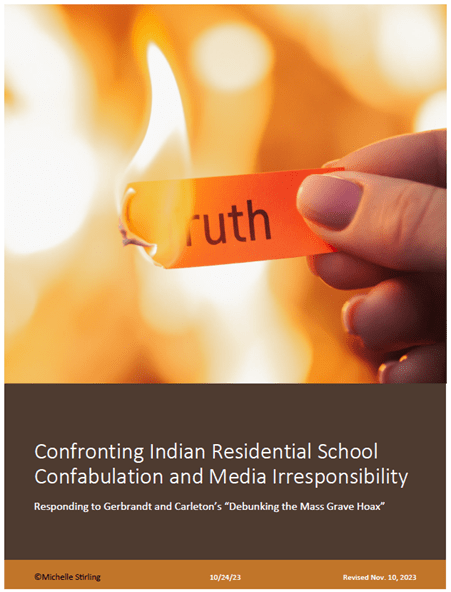
Canada is in the grip of a ‘mass grave/missing children’ psychosis related to Indian Residential Schools. The ‘shock and awe’ media campaign that accompanied the statements by the Kamloops First Nation in May of 2021 claiming that clandestinely buried children’s bodies or remains had been found in an orchard thanks to a Ground Penetrating Radar (GPR) search sent shock waves around the world.[1] Contrary to claims in the Reid Gerbrandt – Sean Carleton report, “Debunking the “Mass Grave Hoax”: A Report on Media Coverage and Residential School Denialism in Canada” the media never corrected these stories.
In addition to rebutting the Gerbrandt-Carleton media claims, this report incorporates a number of articles that set the context of some historical events. I also have included a rebuttal to a Sean Carleton paper, regarding the cancel culture that led to the dismissal of Senator Lynn Beyak from the Canadian Senate. Think of this as a plain language media kit on Canadian history relevant to Indian Residential Schools.
This report was updated Nov. 10, 2023 to remove an invalid link.
In this document, I make scant reference to the mistreatment or abuse of former Indian Residential School students, simply because the Canadian government has spent >$60 million and about 8 years documenting those statements, and we are spending >$60 billion in compensation and reconciliatory programs on a population of less than 1.8 million Indigenous people – not all of whom ever went to Indian Residential School of any kind, and so many Indigenous do not qualify for compensation – creating inequity. Despite this huge compensation, most Indigenous people will still live in poverty, with no fresh water and lack of housing while the media continue their focus on witch hunts of elderly Christian Sisters, Brothers, Fathers, and priests, who dedicated their lives to the service of their students, many of whom were orphans.
I am looking for media accuracy, inclusion of historical context in Indian Residential School reporting, and rational reconciliation. I do not ascribe to a ‘settler historian’ view of the world and do not support a grievance industry.
Notice when you are holding onto a grievance. How many minor and major irritations and grievances occupy your thinking throughout the day? What do we sacrifice when our attention is centered on grievances? Heed Hayek’s warning: A “decent society” cannot survive when a critical mass of people is focused on grievances. Living for grievances means risking our humanity and liberty. https://www.aier.org/article/to-live-for-grievances-risks-liberty/
“If we had only been allowed to carry on the business in our own way for another two years, there would have been no trouble now as to feeding the Indians, for there would have been none left to feed: whisky, pistols, strychnine and other like processes would have effectively cleared away these wretched natives.” – Alexander Staveley Hill, Ex-whisky trader, Southern Alberta
Truth and reconciliation are important for healing wounds.
Truth should include historic context.
The historic context of the First Nations and Metis people of the Canadian plains should include the circumstances of the Indian Wars in the United States as well as the deadly smallpox epidemics that preceded the arrival of Europeans in Western Canada.
In the 1860’s, the United States was swept up in a bloody Civil War between the North and the South. Canada by Confederation in 1867 was a country of some 3,200,000 and 662,148 acres of “snow” in Ontario, Quebec, Nova Scotia and New Brunswick. According to Wikipedia, the US population was 31,443,321.
Sir John A. MacDonald had a vision of a unified country of Canada from sea to sea to sea. Sparse population and vast distances made that vision seem impossible.
Captain John Palliser had surveyed the western territories in detail in 1859, and had proposed a plan for European settlement. As the US Civil War ended in 1865, Canadians feared the huge Union Army, with its million-man standing force, might just march into the West – “Rupert’s Land” and take over. (Note: confusingly for today’s reader, the Canadian west was also referred to as the North West Territories in this time)
So, in 1869, the Canadian government purchased Rupert’s Land from the Hudson Bay Company for 300,000 pounds Sterling. British Columbia waited, watching – barred by the seemingly impenetrable Rocky Mountains.
By 1872, survey crews from the US and Canada had set the 49th parallel border – but this invisible line meant nothing to the nomadic aboriginal people who followed the depleting buffalo herds or the white whisky traders, many of whom were ex-Confederate soldiers, hardened by the horrors of war.
At the time, Canada’s entire budget was $19 million – the US was spending $20 Million every year on Indian Wars alone. By contrast to the violence south of the border, Canada had essentially been founded on friendly trade relations between the French and Scottish courier de bois and their aboriginal partners.
But in 1873, trader Abe Farwell witnessed the aftermath of the massacre of his trading partners, the Assiniboine tribe, by American vigilantes who had brutally slaughtered them in the Cypress Hills. He went east to tell his tale and his story galvanized the creation of the North West Mounted Police.
Some 300 North West Mounted Police marched west later that year, across the desert-like region of the great Canadian plains. They came in peace, and within a year restored security to the region by getting rid of the whisky traders and establishing a presence along the border. The “Mounties” (as they became known) later gave sanctuary to Sitting Bull and his people who escaped the US following the Battle of Little Big Horn wherein General Custer and his men had been killed by them.
The truth is, that Canada sent out the North West Mounted Police to protect the nation’s border and its people. A tiny force of 300 men were nothing compared to the US and their cavalry. But law and order prevailed, as did recognition of the invisible border.
Today, we cannot imagine the sea change occurring in the lives of aboriginal people at the time. Tribes had been decimated by smallpox. In the 1837-40 smallpox outbreaks in the US, entire First Nations villages were wiped out. Malnutrition had set in among First Nations as the buffalo – once numbering an estimated 60 million on the plains – had been reduced to about 1,000 by the 1880’s.
A descendant of Rev. McDougall of the Stoney Mission recalled to me that his ancestor had adopted 17 native children as they had been orphaned by smallpox. Likewise, it was the missionaries who created a written form for many aboriginal oral languages, and created dictionaries to preserve the wisdom and knowledge of the people.
The buffalo were disappearing as was the nomadic aboriginal way of life.
Today, claims of genocide and cultural genocide against aboriginal people are bandied about, but in the context of history and the above evidence, it seems this is not true.
The Mounties came to protect, and did protect Plains aboriginal people. There was no intent to wipe out the people.
True – the reservations were never part of the historic treaties. It should be noted that the Mounties found that incoming settlers thought it would be ‘okay’ to shoot any Indian who meddled with their cattle. Separation may have seemed appropriate; especially in light of continued Indian Wars and conflicts in the US.
What of residential schools?
Let’s go further back in time. Let’s look at how E. Pauline Johnson, Tekahionwake, was seen in Canadian and British society (1816-1884). She was a Canadian poet and child of a British mother and Mohawk chief. She was honoured in society; undoubtedly a role model for Indian Affairs authority Duncan Scott who was also a poet (1862-1947) and who likely felt this type of ‘foot-in-both-cultures’ person would be the outcome of his department’s work. He shared a view many Canadians share today: “I do not think as a matter of fact, that the country ought to continuously protect a class of people who are able to stand alone…”
As evidence, Pauline Johnson, a mixed race woman, managed to stand alone- even before his time. And she paddled her own canoe.
She dressed as and dined with British high society; she performed in Anglo and Mohawk attire. Ms. Johnson herself had only 3 years of Indian day school education, yet became a writer; both parents being literate.
Schooling for anyone in the early days of Canada was considered a luxury. Prior to 1880 in England most children aged 4 and up were working! Poor children in Britain were not provided with free public education; boarding schools were the norm only for the well-to-do.
Consequently, in Canada First Nations children were provided with what white children were often denied – free, full education.
That the methods were heavy-handed cannot be denied; some brutal disciplinary methods, like caning, were the norm in British society right up to the 1990’s.
Disease
First there was smallpox. In the 1837-40 smallpox outbreaks in the US, entire First Nations villages were wiped out. Malnutrition had set in amongst First Nations as the buffalo – once numbering an estimated 60 million on the plains, had been reduced to about 1,000 by the 1880’s.
Next, the Spanish Flu of 1918 wiped out an estimated 50-100 million globally. Records in Saskatchewan show that those who died were buried as soon as possible to avoid further contamination.
“Nearby, he found three Indians lying dead, and not far away a young man worked alone to dig graves for his parents and his brother and sister.” At least 20 First Nations children are recorded as dying in one residential school alone at that time of Spanish Flu.
Consequently it is no surprise that residential schools were planned with graveyards. Death was common.
That many children died there should come as no surprise. Death was common across Canada from tuberculosis up until the 1950’s. Tuberculosis (TB) was often considered a shameful thing within families, never to be mentioned.
“TB ravaged First Nations people in Saskatchewan as early as 1884. Death rates ten times higher than among whites were due to drastic changes in lifestyle, poverty and overcrowding.”
Dr Ferguson’s surveys of Indian schools and the reserves of the Qu’Appelle Valley in the mid 1920s, showed that up to 90% of First Nations children and adults were infected with TB. (Wherrett 1977:109; Houston 1991:94-95)
More orphans were created by the Spanish Flu of 1918. This hit young adults more than grandparents or children.
In her book, Eileen Pettigrow, tells of a travelling salesman who called at a store at Paradise Hill and found both the proprietor and his wife dead. “Nearby, he found three Indians lying dead, and not far away a young man worked alone to dig graves for his parents and his brother and sister.”
Read also how many people died in unmarked graves – buried as soon as possible in the hopes of stemming disease, even though they were adult white men from out of province – their bodies were not allowed to be sent home and they ended up in unmarked graves…just like many aboriginal children: “During the flu epidemic of 1918, harvesting was still going on, but the operations ceased because of illness of the crews. There are stories of entire threshing crews – many of them men from the East who had come west on harvest excursions – found dead as a result of the flu. At Strongfield it was reported that in one nine-man threshing crew (all transients), seven of the men died in a bunk car.
Aimee Hill recalls that when the Methodist Church at Hawarden was turned into a
hospital, her mother offered her services as a practical nurse. “I recall her telling of her
experiences at that time, when men, sometimes name and home unknown, lay dying alone
among strangers” Hill writes. “I remember seeing three coffins, piled one on top of the other,
sitting outside of the church awaiting burial in a common grave.”
To give an idea of the scope of this epidemic, in Pittsburgh, 1 in every 100 people died of the flu. Here is a record of the carnage in Alaskan villages.
First Nations peoples in Canada have suffered, no doubt. But – they have survived.
First Nations and aboriginal people in Canada were not slaughtered as in the US Indian Wars. The intent of residential schools of the 1880’s was to provide them with a way to integrate into European-style society, become literate and thus become independent. That’s not genocide.
A 1948 Geneva Convention definition of genocide specifically applies to circumstances of armed conflict. Protecting public health and providing education so that a people can ‘stand alone’ does not constitute genocide, no matter how brutal the methods were by today’s standards.
And still today there is a need for education for aboriginal youth in Canada. The aboriginal youth of Canada don’t need sheds for canoes and paddles, as Prime Minister Trudeau recently said.
The aboriginal youth of Canada need a way ‘in’ to society – a hand up – education and acceptance.
One way is to bring practical training to the reserve. It’s been effective in Alberta for many. Maybe it will work elsewhere too.
But… how about housing? Fresh, safe water? Hope.
How about a balanced telling of history. Without residential schools, many thousands of children would have died of disease and malnutrition. Without the early work of missionaries and traders to document the oral languages with a written alphabet and dictionaries, these languages would have been lost.
In these same times, in the European world, children were often given up to orphanages when poor widows could not support their needs. Homes frequently burned down as kerosene lamps were used. People died of diseases and infections we can easily treat today. Death and unmarked graves were common to all.
Residential schools were a product of their time and context. It is only fair to set that context first when discussing truth and reconciliation.
~~~~
NAIT-in-Motion Aboriginal Trades Training comes to reserve:
On July 5 and 6, 2024, FreedomTalk explored the topic of “The Decline and Fall of the West: Our Choice?” I decided to address the most significant duping of Canadians, ever. I’m referring to the genocide claim of mass graves of children found in a Kamloops orchard made by the Kamloops First Nation on May 27, 2021 – the shock of which allowed the United Nations Declaration of Rights for Indigenous Peoples to sail through parliamentary approval within a month, despite it having been contested by six provinces and some First Nations bands for months prior.
Many people at the FreedomTalk event wanted the chance to review the power point and links in more detail. I’ve posted the ppt below the FreedomTalk video, which is all cued up for the start of my presentation. People at the event were not aware of many of the issues I raised in my presentation – so please do share with friends and family and politicians. UNDRIP requires that ALL laws in Canada be aligned with UNDRIP, according to the Justice Department. You will see how problematic that becomes when things happen like the BC government ‘giving’ Haida Gwaii islands back to the Haida Nation. This is likely unconstitutional, and will end up with years of wrangling in court; if passed, every First Nation in Canada (of which there are 634) will demand similar or equivalent ‘land back.’
Someone has tried to cancel the publication of this paper which rebuts claims made by Sean Carleton of the University of Manitoba, about a paper that he did about Senator Lynn Beyak’s efforts to have people recognize the enormous good that Indian Residential Schools provided for thousands of children. Yes. Some children also suffered harms. Not everyone.
Carleton is a self-described ‘settler historian’ and part of the ever ballooning Indigenous and ‘pretendian’grievance sector of Canadian society. There seems to be a parallel universe where mainstream Canadian life goes on as normal, while in settler historian-Indigenous grievance circles, there is an ever increasing ‘tab’ that mainstream society must pay for reconciliation. Most taxpayers are completely oblivious to these multi-billion dollar costs for questionable ends. At this point in time, based on the most recent budget, that tab is quite high. Of the approximately $35 billion deficit in the past fiscal year, about $26 billion (74.3%) was for the satisfaction of Indigenous claims. It should be recalled that Canada’s Indigenous population is about 1.8 million. Though people point to the reports of the Truth and Reconciliation Commission (TRC) as evidence of mortal and moral wrongs, it should be remembered that only about 6,000 people(or 4% of the total residential school student base) provided their recollections to the TRC (not subject to evidence or cross-examination); more than 150,000 students went to Indian Residential Schools. Many were orphans, saved from the worst of fates by Indian Residential Schools run by Catholic Sisters and Brothers, or by other Christian denominations. Many who claimed they were forcibly taken to Indian Residential Schools were actually enrolled by their parents (if one looks at the records); and others were rescued from destitute, dysfunctional or dangerous homes.
As Robert Carney wrote, rejecting the Royal Commission on Aboriginal Peoples report of 1996, “The work of the traditional boarding schools is similarly ignored in the chapter’s introductory section. The fact is that in addition to providing basic schooling and training related to local resource use, they served Native communities in other ways. It would have been fair to acknowledge that many traditional boarding schools, in some cases well into the twentieth century, took in sick, dying, abandoned, orphaned, physically and mentally handicapped children, from newborns to late adolescents, as well as adults who asked for refuge and other forms of assistance.”
Robert Carney, father of the much more famous Mark Carney (who curiously does not speak out in defence of his father’s life long research) , showed that government and media analysis of Indian Residential Schools were/are flawed from the get-go. Canada’s Indian Residential Schools saved thousands of orphans. Saved children!!
So, here is the abstract of my paper rebutting ‘settler historians’ and their world view. The full document follows. Enjoy!
~~~~
Settler Historians Need More Education, Less Ideology Rebutting Sean Carleton on Senator Beyak and Indian Residential Schools
Canada, once honored worldwide as a nation of peacemakers, is presently accused of genocide by China; condemned as a colonialist purveyor of genocide by a bevy of self-described ‘settler historians’ within Canada. The focus of the alleged ‘genocide’ is the establishment of Indian Residential Schools and the outcomes thereof for some 150,000 Indigenous students over the course of ~100 years. The evidence of this alleged heinous crime is said to be in recollections published in the reports of the Truth and Reconciliation Commission in 2015, which, contrary to Carleton’s abstract, only claimed the schools constituted ‘cultural genocide’ – nothing more. Carleton (2021) assesses the instance of Canadian Senator Lynn Beyak attempting to provide diverse perspectives (typically positive) on Indian Residential Schools as a case of ‘residential school denialism.’ This work will provide historical evidence rebutting Carleton (2021) which presented theories of ‘denialism’ but little actual historical evidence to support his case.
I am not an academic, but from time to time I enjoy writing papers that are critical of various academic papers, simply as an exercise in critical thinking for myself. I generally focus on debunking the alleged 97% ‘consensus’ and I post them to some pre-print sites to see if other people share or reject my findings. I find the peer-review process of most journals to be belabored and too long. I am interested in the exchange of ideas.
A couple of years ago I ran across a paper by Timothy J. Haney of Mount Royal University which purported to present the contrarian views of a number of Calgarians energy executives on climate change. I found it strange that in the paper he said his research team did not ask his interviewees any direct questions about climate change. Also strange that the interviews had taken place in 2014-15, but the paper was published online in 2021 and print in 2022.
So, I wrote a critique of the Haney (2022) paper and posted it, as usual, to a pre-print site, and subsequently published it in a small overseas journal.
This fall, parties unknown to me made vociferous and successful efforts to have my work taken down.
Thinking that I had perhaps made a colossal error in analysis, I went back to the Haney paper, only to realize that his paper recycles comments from interviews that were intended to report on emergency preparedness and awareness, related to the catastrophic Calgary flood of 2013. This is why no direct questions were asked about climate change. It was not the topic of the interviews.
From the style of Haney’s published paper, I doubt very much that participants provided Informed Consent for this type of use of their 2014-15 comments, where no direct questions had been asked about climate change. I believe this to be a fundamental violation of research ethics and one that causes harm to the participants, despite them being ‘anonymized.’ I believe it causes harm to Calgary and to Alberta in terms of reputation and investment, not because it is critical but because it is inflammatory and – not based on answers to direct questions about climate change.
It was a complete surprise to me, while doing the research, to find out the mocking Haney references to his interviewees referring to “Climategate emails” as a conspiracy theory about back-room manipulations on climate science turned out to be true! Haney also mentioned Friends of Science Society five times. I am the Communications Manager for Friends of Science Society, though this is an independent work.
Indeed, though I had scanned through some of the Climategate emails years ago, I had not read them thoroughly. There are a huge number of them so in the Lavoisier Annotated edition, I randomly entered the name “Sallie Baliunas,” who was Friends of Science Society’s first scientific advisor, in the search bar of the pdf. I was astounded to find that there had been a concerted effort by various high profile climate scientists – not to dispute or debate ‘the science’ – but to delegitimize or destroy all of our early scientific advisors’ reputations, and to destroy one of the journals where one of our scientific advisors was editor.
A word cloud of the Haney paper.
So I am posting my paper here for people to review and comment on. I apologize to readers that some segments of the paper are now a bit repetitive. I added a bit about my recent review of Haney’s paper and what I believe are ethical violations of informed consent. I don’t have time to spend days rewriting. I did not receive a juicy SSHRC grant for my work, I do not have a well-paid university academic position. I did this work in my spare time in an effort to enlighten the broader Albertan and Canadian taxpaying communities as to how your tax dollars are being used against jobs, industry and our international reputation and about how twisted and convoluted the claims of a ‘climate catastrophe’ really are. I am outraged that graduates of the most difficult disciplines in the physical sciences like engineering, geosciences, and international energy commerce are having their reputations smeared by climate activists and academics in the soft sciences.
My work was not funded or directed by any party or industry.
Comments are quite welcome as are donations. Please keep it civil.
Most governments, at least those of the West, abhor genocide – a heinous crime described by the UN Geneva Convention as:
The definition contained in Article II of the Convention describes genocide as a crime committed with the intent to destroy a national, ethnic, racial or religious group, in whole or in part. It does not include political groups or so called “cultural genocide”.
The consequences for participating in a genocide can be imprisonment or execution.
So, it is strange that the government of Canada – the entire House of Commons – accepted NDP MP Leah Gazan’s motion of Oct. 27, 2022 to ‘describe’ Indian Residential Schools as genocide, without debate or evidence presented.
Stranger still that the federal government is pumping millions of dollars into the University of Manitoba for the National Centre for Truth and Reconciliation (NCTR), when all that organization appears to be doing is falsifying and rewriting Canadian history and it has not even managed to make public the provincial death records that were handed over to its predecessor – the Truth and Reconciliation Commission – in 2014.
A decade later, the NCTR, an organization operated by the University of Manitoba, with a mandate to make all such public records available to the public, still has not done that.
Why?
Is it because the facts of history would destroy the genocide narrative?
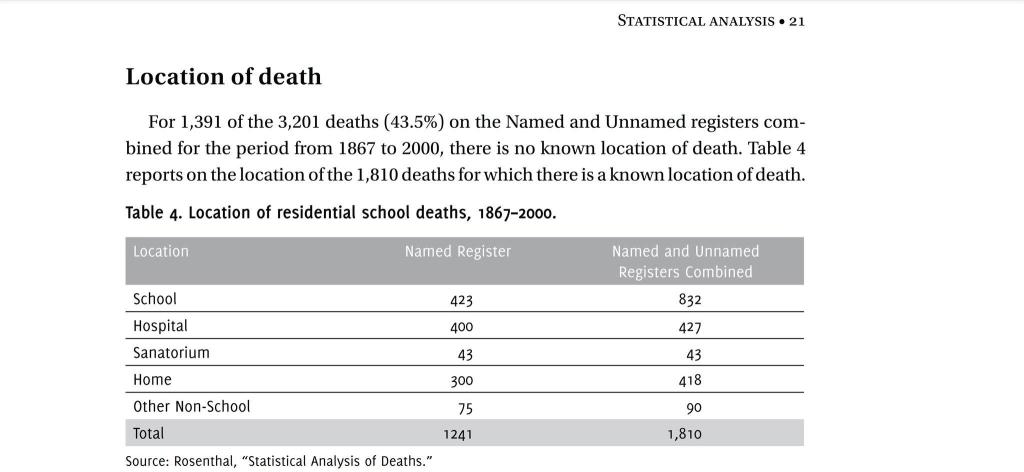
The historical documents show that most children enrolled in Indian Residential Schools were enrolled by their parents. Rather than thousands of deaths as alleged, there are 423 who died at Indian Residential Schools. That’s out of 150,000 attendees over the course of 113 years. Some genocide.
So, the historical documents show that what Marie Wilson, Commissioner of the Truth and Reconciliation Commission said in 2015 is not true:
Parents had their children ripped out of their arms, taken to a distant and unknown place never to be seen again, buried in an unmarked grave, long ago forgotten and overgrown.[6]
The records show that parents voluntarily enrolled their children to these schools. Parents were allowed to visit (though sometimes distance precluded that). Children returned home for festive and summer holidays – unless the children were orphans or if their home was dysfunctional and dangerous. In that case, those children might have been apprehended – ‘ripped out of their arms’ – to protect the child from serious alcoholism, physical or sexual abuse, or simple neglect in the home.
Even dysfunctional parents love their children, but can society allow small children to remain in a home alone when the parents might be gone either trapping or drinking for days on end?
Independent researcher Nina Green has painstakingly analyzed the death records by Indian Residential School and band in British Columbia. She has identified the cause of death and where the child’s body was buried (with few exceptions) and created an excel chart that anyone can review. (See the two files below)
The death records from the provinces that Nina has compiled for British Columbia show that the children were accounted for and most of those who sadly passed away, were sent home for burial on reserve. In extenuating circumstances, they were buried in the mission or community graveyard near the school with full burial rites according to their family’s denomination, and with a marker, that has disintegrated over time. The cause of death is also noted.
How can an individual researcher like Nina Green accomplish this work alone when a multi-million-dollar tax-funded operation, soon to occupy a multi-million-dollar edifice on the University of Manitoba campus, fails to even get the death records posted and available to the public as per their mandate?
Why is the federal government and a major tax-funded Canadian university driving the genocide narrative on Indian Residential Schools – in flagrant opposition to the evidence – creating strife, division, mistrust, fear and complicated grief for so many Canadians, especially Indigenous people.
Why would the federal government push such a narrative when China has accused Canada of genocide at the UN, along with a handful of other terror states?
Why wouldn’t the Canadian government and all politicians at all levels of government want to defend this country and our citizens from false charges?
Now it is clear why key players in this drama are urging the government to make Indian Residential School ‘denial’ – and the presentation of facts like these – a criminal offense.
Is it to cover up the falsification of history and the fact the Canadian taxpayer is being defrauded?
What is the end game? We don’t know.
According to Nina Green’s research, the Memorial Register of the NCTR includes names of people who died unrelated to Indian Residential Schools, thus creating a false impression that thousands of children died there or are missing. Screenshot above from this CTV News story of Sept. 30, 2019.
-30 –
Michelle Stirling is a member of the Canadian Association of Journalists. She researched, wrote, and co-produced historical shows about Southern Alberta under the supervision of Dr. Hugh Dempsey, then curator of the Glenbow Museum. She also researched and co-wrote a documentary on genocide; the factual content so dark the producer decided not to release it.
I am very concerned right now about the situation in Canada, regarding the claims of genocide and the search for unmarked graves and missing children.
I’m very sad that the international media has picked up the story and is calling it a hoax. Because I think a lot of people are really hurting.
I think that a lot of people are missing loved ones. I think a lot of those losses are what’s called ‘ambiguous losses,’ where people left your life, or some traumatic event happened, and your life changed dramatically.
And I think a lot of the focus of these ambiguous losses have been put under the umbrella of the Indian Residential Schools as the only reason for all the grief and loss.
So I wanted to tell you a bit of a story, when I was in Calgary in the 1990’s, I was walking down the street and this fellow stopped and asked me something. And I answered him in Blackfoot. And we both started laughing, probably because my Blackfoot wasn’t very good. But he was surprised. Anyway, we got a couple of sandwiches, we went and sat in the park, and we talked for a while.
His name was Fred Yellow Old Woman. I got to know him, like, pretty well. We weren’t best of friends, but we ran into each other quite a bit. He told me a very interesting and moving Blackfoot story, which I thought probably should be turned into a play. So he actually took me to the Blackfoot elders and asked their permission if I could turn it into a play and I did that. But unfortunately, that play is in an attic somewhere overseas.
And I’m here.
But let me tell you what it was about.
And I think that it’s okay that I just tell you, because I did have permission to write it.
It’s about the fact that all of us are stones.
We are all like stones. We’re all the same and we’re all different, all at the same time. Some of us are big stones, we are strong. We don’t need anybody. And some of us are small stones and we’re blue and we’re sad. And I think the stones of the people who are missing their loved ones are like this stone… which reminds me of my brother. And I actually keep it by his photo. On the outside it looks black and not very interesting. On the inside it’s red and like a wound, because he died a few years ago, and I still miss him.
And some people are probably …blue.
They are like blue stones. They also are hollowed out inside, maybe from depression, loss, fear.
And other people are stones with healing going on inside.
Where that loss is gradually moving on and growing into some new strength. The wound is still there, but there’s new life. And some people have maybe taken their grief and moved it into something pure, and some sense of purpose, maybe living for the person whose life was lost.
Because, you know, when we lose someone we love, I don’t think any person who has gone to the other side wants you to spend your life in sorrow….over them going on.
That was their path, not yours.
Your path is here.
So, I think many people take that loss and turn it into something constructive for themselves.
So I see that there’s a lot of anger right now in all of the communities in Canada about this whole issue.
There are some people who feel that it is a hoax, that there are no missing children or unmarked graves. People are demanding, ‘let’s see the body’ which is not the thing.
Even if you found a body of someone, in a grave, that just means that someone died.
You know, back in the day, when a lot of these graveyards were set up and the ground was sanctified by the church that was running that mission outpost..a lot of people died then from illness.
You know, if you got a little cut on your finger and it got infected, without antibiotics back then, you could die just from that. Or a broken leg if it wasn’t set properly, you could die from that.
And of course, TB – tuberculosis – was very prevalent back then.
So, thousands of people died of TB. In fact, in one book I read, the author said that in 1908, in Canada, every hour of the day, one Canadian died of tuberculosis. And at night, two people died every hour from tuberculosis.
And there was no cure. Up until about the 1950s when they developed streptomycin, I think it is, and some vaccines, there was no cure.
And it was a very sneaky kind of disease, you could have it for a long time and you wouldn’t know, necessarily, that you had it. Maybe you got more tired, maybe a few body functions didn’t work as well, maybe sometimes when you coughed, blood would come up, and then all of a sudden there could be a catastrophic hemorrhage from your lung.
And that would be it.
So, and at other times, it was actually known as ‘consumption’ because it would literally eat a person away from the inside out. Just made them into a skinny wreck.
So I think, you know, if people haven’t studied Canadian history a lot, then they might have a lot of false impressions about what went on.
You know, I see online people say “Well, why would a school have a graveyard?”
The main reason is that a school was usually set up beside a Christian Mission first, and the mission outpost always had a graveyard because, like I said, so many people did die in those days. And the whole purpose was to sanctify the body and bury it in sanctified ground and release the spirit back to G-d, the Creator, the Great Beyond, whatever you want to call it. And then after that, the residential school was built nearby. So that’s why there was a graveyard.
And there are some residential schools that were kind of built in the middle of nowhere – they also had a graveyard, because also people died. And you know it wasn’t only people, children going to residential schools who died from time to time.
As Robert Carney wrote in several of his writings before there were social services and Universal Health Care, these outposts, these residential schools and missions, this was the only place that anyone could go for help. So if you were a traveler going across Canada, a prospector, a trader of some kind, and you needed help, let’s say you got hurt or your wife was going to have a baby, or you were hungry, maybe you were not successful on the hunt…the place that you went was to the mission or the residential school. And they gave whatever help they could, but sometimes people died.
So there will be people in these graves who aren’t necessarily identified. Because, back in the day, a lot of people didn’t even carry ID. What did you need it for? Out in the middle of the prairie.
So these are some of the things, the facts of history, that we have to look at, that we have to be willing to consider.
We can’t just be demanding bodies, and we can’t be saying that even if there is a body there was something nefarious or evil done, because so many people died back then…just of disease.
And you know, there probably will be some mass graves found, if people continue looking, and that would be related to things like Spanish Flu. Because when the Spanish Flu epidemic hit, it would wipe out whole groups of people. Whole families. You know, 10-20 people at a time. Because it struck very rapidly. Someone could have a fever in the morning and be dead by evening.
And if that was happening in a community, there was no one to bury bodies one by one.
So, there are instances, and they are documented that the best thing they could do was to dig a grave and put a lot of people there. Usually they tried to document who died.
But again, I’ve read passages in Saskatchewan you know the harvesters would come from Ontario, down east, to come and work the harvest out on the prairies, you’d have 9 or 10 guys in a boxcar coming west for harvest time, and they’d open the boxcar and they’d all be dead. From Spanish Flu.
And that was a strange flu. You know, it hit for a couple of years, I think it was 1918 to 1920 and it came in two waves, and then it went away. That was it.
But in that time, it also took a lot of parents. It hit young adults hardest. And it left a lot of orphans. And a lot of those orphans ended up going to residential school – that became their home.
So, I hope that gives you some insights.
And… uh.. I probably talked long enough. But, I hope that we can calm the situation down, and talk with each other.
In the early 1980’s, I spent several years working on a series of historical documentaries for CTV Calgary. My research supervisor was Dr. Hugh Dempsey, then curator of the Glenbow Museum. The project meant our tiny production crew had to drive all over Southern Alberta to interview hundreds of people – pioneers, historians, and descendants of those who signed Treaty 7. Many hours were spent in the Glenbow Museum combing through archival images and documents; in my spare time I was reading history books. I learned things I had never been taught at school, about things that happened in my own ‘backyard’ and I grew to love Canadian history and Canada.
I grew up in Ponoka, Alberta, just south of Maskwacis (then called “Hobbema”). This is the townsite for the four First Nations bands: Samson Cree Nation, Louis Bull Tribe, Ermineskin Cree Nation, and Montana First Nation. Years later I worked in Ponoka as a sub-contractor to Alberta Human Resources as a career and employment officer. About 30% of my clients were aboriginal. At the time, the total population on reserve was about 13,000 people. Unemployment on the reserve was about 90%. Most of the Indigenous young people I met were bright and eager to find a way into the larger society, and all they wanted was a hand up, not a handout. I saw great promise and had great hopes for them. Many found rewarding work; some found opportunities in the skilled trades through the innovative NAIT-in-Motion/First Nations Training-to-Employment program that brought the classroom to reserves across Alberta.
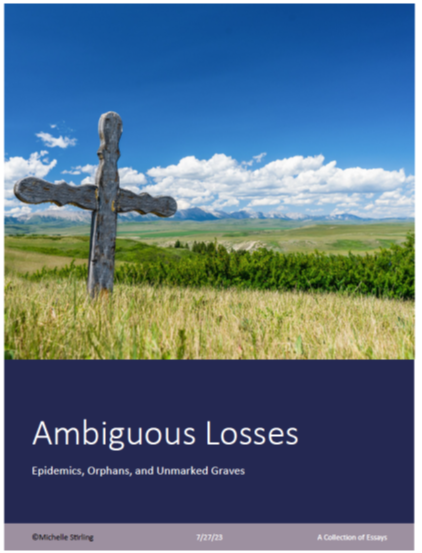
I find the present public obsession with Indigenous graves and genocide destructive to the future of Indigenous youth and the future of Canada. I do believe that people are missing loved ones, and I believe it is related to the phenomenon of ‘ambiguous losses’ as outlined in the forward. Based on the research I have done, I don’t think there will be many unmarked graves or unidentified missing persons found because historically, the children at residential schools, hospitals or sanatoriums were well documented, simply because the funding for the child came from the government, and documents had to be in order. I do believe that there are some cases where names were confused due to being anglicized, or where a child may have been sent from a school to a hospital, then on to a sanitorium for Tuberculosis treatment, and then perhaps on to a different school – and thus the child was ‘lost’ to friends and community – but not to the system. Certainly, for all the children in that school, when a classmate disappeared, sent away for treatment, it must have been jarring. And for the patient – terrifying! Some TB treatments took many months or years, so indeed, that person became ‘missing’ in the lives of students, even if they still existed elsewhere. TB had a tremendous stigma to it then (as it does now in the northern Inuit communities) so that people did not talk about it socially. It was a frightening, forgotten plague that loomed, like the Grim Reaper, over every family in all of society, up until about the 1950s when vaccines and antibiotics were developed.
I hope this collection of essays might offer some insights on this complex and, for many, painful historical topic of Indian Residential Schools. Some vignettes are repeated in the essays as they were written at different times.
We are on a dangerous path. Truth commissions are temporary, official, and non-judicial bodies set up by states to examine past violations or crimes, generally to foster lasting peace and/or reconciliation (Freeman, 2006; Hayner, 2011; United Nations Secretary General, 2004).[1] Instead, we’ve had church burnings, threats of violence and now demands to censor those like me who teach history. There are calls to silence people like me who present a broader view of Indian Residential Schools – broader than missing children and claims of genocide. I present the missing historical context. I am a ‘factualist’ – for I am now an elder of my society, carrying on the traditional teachings that I learned from Potai’na – Dr. Hugh Dempsey, and all the other elders from the 1980’s documentary work, who entrusted me with their stories, to carry them forward to the future, so that people would better understand the past.
I choose life. I press on. All these things of my life’s experience have driven me to write this down for you, knowing how contentious some issues are, because I must tell the truth and be honest. That is my sacred responsibility to those who taught me so much. – Michelle Stirling, July 27, 2023
[1] Genocide Against Indigenous Peoples: The Experiences of the Truth Commissions of Canada and Guatemala
A response to Tanya Talaga’s “Finding Annie” in the Globe and Mail
When I was in high school, we were given a take home assignment to write about a great man in Canadian history. Sir John A. Macdonald had already been taken, as had other well-known shapers of Canada. So, I bounced the assignment theme off my dad, who was a graduate of Rye Grammar School in England, a British boarding school, where he had both received an excellent education in the Classics and been bullied by fellow students and beaten by teaching staff for his crime of being left-handed.
I thought Dad would come up with some historical figure like General Wolf, who I knew almost nothing about but had heard of. But no. To my astonishment, he suggested that I write something about my own Grandfather. His Dad.
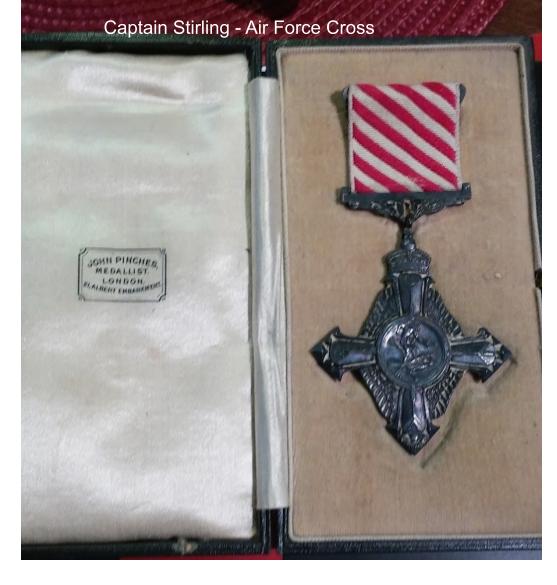
Captain Robert Millar Stirling. Aviator.
It may be hard to believe, but until that time, I had never really heard of my paternal grandfather or his exploits. I had grandparents on my Mom’s side of the family; Grandpa Frank was also a war vet and played the Last Post at all Remembrance Day services in his small town for decades. His son, my Uncle Frank (Mom’s brother) had been shot down on return from a night raid over Essen during WWII. So I guess I conflated war and death and people….because Dad never spoke of his father. I had never met either of them, of course, so… just someone missing in my life. Disappeared. Missing.
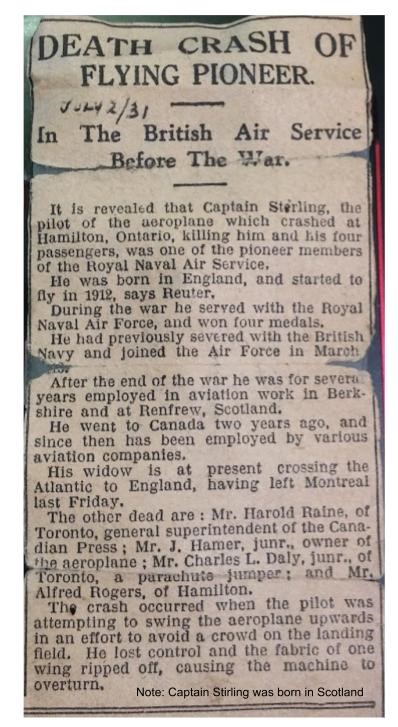
In one way, it is simple to understand why Dad never spoke of him until I was older. My father was 10 years old when he and my grandmother were on a boat back to England to visit family. His father, Captain Stirling, died in a plane crash on the Hamilton airport runway in Ontario, while leading the first civilian Canadian Trans-Canada Air Pageant.
My father never saw his father again. Imagine the shock! There was no turning a steamship liner around to allow my grandmother and dad to attend the funeral in Hamilton, Ontario. My Dad never neared his own father’s grave until a winter in the 1960s when he returned from England and his mother’s funeral. He found himself in Hamilton, Ontario (whether by accident or design I don’t know) and he made a trip to the wintery graveyard to finally pay respects to his father, 38 years later.
So overall, it makes sense that my paternal grandfather, Captain Robert Millar Stirling, famous in life, became anonymous in death. Invisible to me until that fateful high school assignment.
My father and I were always very close – soulmates. That’s how I describe our relationship. The loss of his Mum was devastating to him. I know that. Even as I child I felt a profound change in him – a former Brit really ‘cut loose’ from his moorings in England.
Though we did not talk about it a lot, I knew he had visited his father’s grave in Hamilton. He’d been there in winter, so he never elaborated on what he’d done or found. I imagined he might have brought a rose or a few to lay on the gravestone and that for him, there was closure.
So, when my father suggested my grandfather, Captain Robert Millar Stirling, as the topic of my history paper, I said ‘sure’ – and started taking notes.
Entry 448:
Nov. 13, 1915 The Royal Aero Club of the United Kingdom, Official Notices to Members reported newly licensed aviators, including:
I was a child – a teenager – at the time with a very limited view of history. I took good notes from what my father told me, but it was only years later that I realized how incredible it was that my grandfather, with flying license number 668 from the Scottish Flying Club in 1913, had decided to come to Canada to Baddeck, Nova Scotia. Remember that the Wright Brothers first flew long-ish flights only in 1909!
Why did he choose Nova Scotia? Possibly because Alexander Graham Bell was an aviation fanatic!
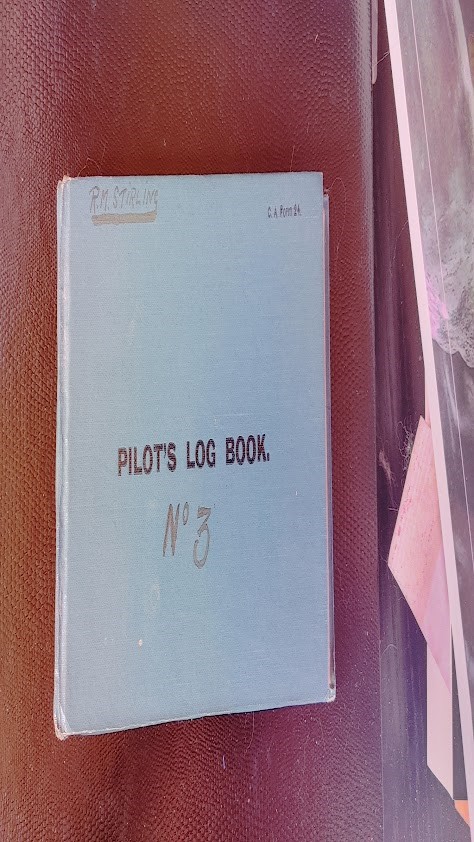
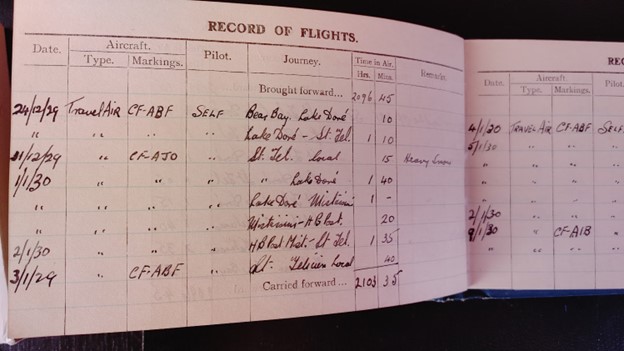
Captain Stirling did not remain in Nova Scotia but moved on to being a bush pilot in Quebec. He moved the family to Montreal where they lived on Sherbrooke Street while he flew all over the province on mail and medical runs. I have screenshots of one of his logbooks.
He also brought new technology into Canada, bringing the first Curtiss monoplane to Canada from Maine.
In his time, Captain Stirling was a public figure. He loved flying and he loved doing air shows. It is hard to imagine today how ‘new’ flying was as a concept, or how dangerous. Maybe the best reference is one of my favorite films “Those Magnificent Men Men in their Flying Machines.”
In the 2000’s, I met with a couple of senior Canadian Air Force pilots on a business project and happened to have a picture of my grandfather and his airplane on my desk. They both nodded with respect and said: “Oh. The flying coffin.”
At one point, for reasons unknown to me, Canada’s top professional speed skater gave my father (then a child) a set of speed skates. I suspect it was some kind of honor related to my grandfather – the fellow I never knew. The man that no one talked about when I was growing up.
But my high school history project had ignited a slow burning spark. A curiosity.
So, many decades later, I planned a road trip to New York. I thought that along the way it would be a simple thing to stop in Hamilton, Ontario at Captain Stirling’s grave, offer a symbol of memoriam, perhaps some roses, and somehow complete a circle of life/death/remembrance that my father had started after my grandmother’s passing in England. [For people who don’t live in Canada, Hamilton is 3,174 km (2,083 miles) from Calgary.]
In 2013, after a few emails to the Hamilton Cemetery, I embarked from Alberta on a trip in my late Mom’s van to New York, planning to honor my father and grandfather with a stop in Hamilton.
The Hamilton Cemetery people were very helpful, except for the fact that they referred me to a block of land where there were no grave markers.
What!
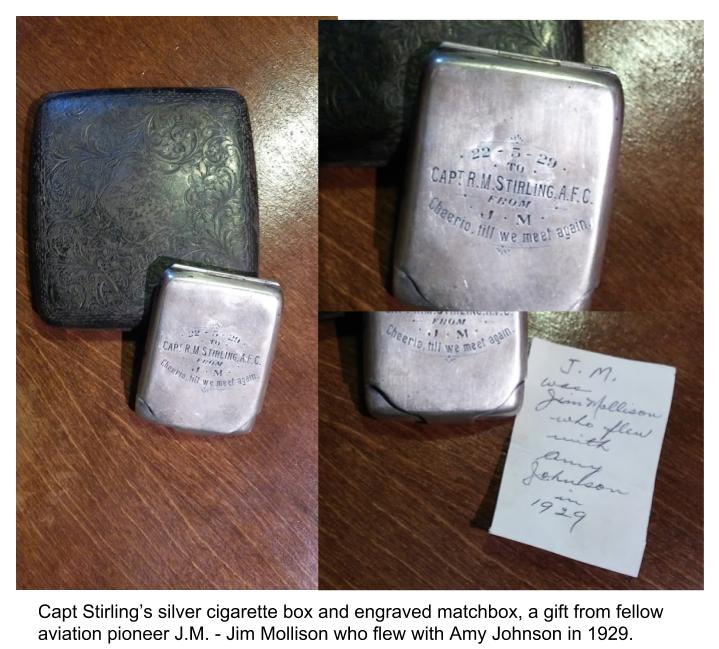
Yes, it turns out that my grandfather, a decorated World War I veteran who received a special letter of distinction from Sir Winston Churchill for his efforts, who was a contemporary of Jim Mollison and Amy Johnson, and who was the leader of the first civilian Trans Canada Air Pageant… lies in an unmarked grave in Hamilton, Ontario.
Cover of event post card courtesy Robin McKee
To me it is clear why his grave is unmarked. His colleagues and promoters were with him on that fateful flight, when, while coming into land, hundreds of people had spilled out onto the runway to watch the plane. To avoid landing ON them, he pulled up sharply on the stick, the stress of which caused the fabric and wooden wing struts to rip apart. The passengers crashed and died – but their sacrifice saved hundreds of others from probable injury and death had Captain Stirling proceeded with the landing path. He did not know that technology and engineering would fail him at a critical time.
Captain Stirling’s wife and son were on their way back to England on a steamship, unable to spin around and return.
Who knows what their financial circumstances were at the time. It is my impression from limited access to documents that Captain Stirling, while adored and revered by his wife Evelyn and many members of the public, was seen as something as a ne’er do well by the parsimonious Scottish end of the family (his own; probably his main financier). My impression is that he was seen as completely impractical by the fruit and vegetable farm family of his wife, who were far too busy harvesting produce and fruits for sale in Covent Gardens to worry about some idiot who wanted to fly across Canada. For what?
The terrible crash in Hamilton left the farm family in Kent, England, ‘saddled’ with the widow and her son, my dad, then a boy of 10. At least the farm family did bring them home. My Gran became the farm manager – to all reports a very good one. But ‘the kid’ was a problem. Not that he misbehaved. Just that he was ‘there.’
It could well be that my paternal grandfather had ‘bet the farm’ on his participation in the Trans Canada Civilian Air Pageant. Maybe he fried all the family’s financial future.
What is clear is that when my dad and my grandmother returned to England, the practical and cultural ‘choice’ was that my dad go to a boarding school (aka residential school). This offered many benefits to my grandmother and her family, who had been kind enough to bring her back into their fold (many families were not so kind to widows with a child – not then; not now!). My grandmother was working, busy as the farm manager, in charge of bookkeeping, logistics, human resources and paymaster – handing out hundreds of weekly cash pay packets to the many workers who came to hand-pick the apples, cherries, hops and produce that Kent farms were famous for. She could work, carefree, most of the year, and in the meantime, her son, my dad, was cared for and educated at Rye Grammar School.
#OnThisDay 1972: "The generation of today will never come like we have." Nationwide met some traditional hop-pickers in Kent. pic.twitter.com/OgU8uExBIY
That conditions for my Dad were not perfect is representative of hardships of the times. My Dad recalled how starving Irish farmers made their way to his maternal grandfather’s farm in Kent, looking for work – not for money – but for potatoes. And how my grandmother made sure they left with sacks full of potatoes.
My Dad was not starving – except perhaps for affection.
My Dad related that when he returned home from English Residential School for the holidays, his uncles frequently beat him up and locked him in closets. Meanwhile, at residential school, because my dad was a southpaw (left hand) he was caned until his hands were black and blue; made to stand in the corner with a dunce cap on. Then he was bullied by his fellow students for being a dunce. He was also called “Fatty” and I have a wooden headboard that his classmates had made for him with “RIP Fatty.” Imagine. Classmates who want you dead.
Cruel as this was, it was quite the norm in Britain at the time. Probably the norm in society.
Despite these known offenses against her son, my grandmother and/or her farm family, continued to enroll my dad in Rye Grammar School where he was bullied and threatened ‘all the days of his life.’
And so, decades later, I arrived at the Hamilton Cemetery in May of 2013, expecting to see some kind of memorial or grave marker for Captain Robert Millar Stirling, only to find there was nothing. NOTHING. Not only that, while cemetery staff could provide an ‘area’ description of where he was buried, it was a big ‘area’ – one with no markers!! Not for him!
Captain Stirling is in here, somewhere. Unmarked. But where? Image courtesy Robin McKee.
I was suddenly personally possessed with a sense that I could intuitively ‘find’ his burial spot because of my obvious genetic and spiritual relationship with him. [Just to mention, I have had several undesigned/unrequested unusual ‘prescient’ events happen in my life. As Dad said a few times of me, “You are like your grandmother, a bit of a witch.”]
I felt certain that if I crisscrossed the area I would, at some point, ‘feel’ where he was. Kind of like a human Ground Penetrating Radar scan.
This did not happen. My grandfather is dead and buried. That’s it. That’s the story. Somewhere in Hamilton Cemetery, but I don’t exactly know where though I have spent a few hours ‘near’ there.
And, today, ‘I don’t care.’
I don’t care. Not now.
I do know he was buried with care, and this was documented.
But he is dead.
I am alive.
Shall I spend hours and days and thousands of dollars trying to locate and then exhume his grave to be sure it is him? For what?
What a long ‘dead-end’ narrative. What can be the point, you may be asking.
The point is that almost everyone of us has an ‘unmarked’ grave in our history.
Presently in Canada, the Indigenous community is claiming special rights to land and documents, on the premise that these lands with presumed bodies or human remains are ‘sacred’ and that no one must ever have access to them, unless they are ‘real’ Indigenous people (based on a race-based historical accounting of their Indigenous roots).
But we ALL have unmarked graves in our families, in our past. Why would one set of grounds be ‘more sacred’ than others?
Just as any Indigenous person can access my grandfather Captain Stirling’s records, why should I, a taxpaying Canadian, be blocked from accessing detailed information about Indian Residential Schools – the basis for multi-billion-dollar claims by Indigenous groups over alleged harms they endured while attending Indian Residential School that their parents enrolled them in?
The larger question, why must I pay anything more as penance for educating people who had no written language? People who have since acquired this skill from the dominant society via residential schools and are now posting class actions suits with the very literary skills that millions of taxpaying Canadians have provided them with over the past 150 years.
Sadly, part of the reason of the disconnect with family members, like my Grandfather, lost in the mists of time, is because Indigenous groups only had an oral tradition for carrying on Indigenous history, they do not have as complete a record as I have of my Grandfather’s life – but what I have is honestly also very sparse! And I still don’t know where his grave is!
None-the-less, Indigenous Canadians can likely find out something about their family members who did attend Indian Residential Schools, who, like my Grandfather, are ‘lost in time’ because the Canadian government required all administrators of school facilities and Indian agents to write details of who was who and what was what. Because they could and did write, there is documentation on virtually every single child who was in an Indian Residential School. There may be a few exceptions in the case of orphaned babies; there may be some children who were sent for treatment for TB and then sent on to a different school. I think these would be small anomalies.
I believe that the claims of missing children are related to the Tuberculosis (TB) plague that was prevalent throughout all of society and much of the history of residential schools. I have written about that here.
I am dismayed about one key thing.
People who ~150 years ago could not read, write, or speak English, are now suing/settling Canada and all Canadians on the claim that their cultural truths and practices were harmed, that children disappeared or were murdered at Indian Residential Schools, despite there never having been a missing person report filed in the past 113 years. Despite the fact that the objective of their parents, who had to register the children in schools, was that they just wanted their kids to be cared for and educated while they went off on their trap line or hunting.
Sounds like a different form of $10 day care.
Robert Carney, eminent historian, and father of the famous Mark Carney pointed out in a number of his papers and commentaries that many Indigenous families signed their children up for Indian Residential Schools because they wanted them to have a better future, and the parents had to work – often in very remote locations like a trap line or hunting. That was a precarious world. Many children died in camps or were orphaned…and then taken in to residential schools for care!
While, yes, it was possible to take the kids along, or set the mom and kids up in a mobile camp while the men went forth to kill and harvest game for food or furs, it was much easier to not have to have the kids around while at work. Most parents discovered this during COVID lockdowns when toddlers wandered into the Zoom room, crying and screaming ‘poopee’, in the midst of big business meetings.
Indian Residential Schools are being blamed for having disrupted parenting and the transfer of cultural knowledge, when parents of the time didn’t want their kids to be expert hunter-gatherers. They sent them to Indian Residential Schools so that they could become teachers, scientists, engineers, doctors, and lawyers. As for parenting and ‘cultural genocide’? Well, since 2/3 of Indigenous children did NOT go to Indian Residential Schools, how can ‘cultural genocide’ be the fault of a handful of priests, nuns and ministers? Two-thirds of the child population were untouched by residential schools.
So far it seems the ‘lawyers’ have triumphed. They and the ‘settler’ historians who are rewriting Canadian history to make victims out of every single aboriginal person who ever attended or had anyone in their family attend an Indian Residential School.
Crass as it sounds, now every Indian Residential School unmarked grave is slated to become a cash cow in the reparation claims for the non-existent… or let us say, unproven ‘genocide’ that is now being investigated against Canada by José Francisco Calí Tzay, the UN Special Rapporteur on the Rights of Indigenous Peoples. As Terry Glavin wrote in “The Year of the Graves” – “In the bigger-picture scheme of things, three weeks after the Kamloops story broke, China led a bloc of torture states that included Belarus, Russia, Iran, Syria and North Korea in a condemnation of Canada’s treatment of Indigenous peoples.”
Canada is all in a flurry about election interference by China – but people are blind to the much greater geopolitical impact of the China-instigated genocide investigation, where the unmarked, unexhumed graves are ‘proof’ in the minds of gullible Canadians that we did something terribly wrong…and ‘should pay.’
Canadians seem to not know that when murder or genocide claims are made, there must be evidence, witnesses, an investigation, a trial, cross-examination and… bodies. Especially if there are known locations of graves, and living witnesses who claim to have watched children digging graves in the middle of the night to bury their classmates.
How are these gravesites not cordoned off and excavated by the RCMP as crime scenes? There is nothing culturally sensitive about murder. It’s a crime– if indeed it was committed as claimed. And it was not committed as claimed – then there’s a different crime. Related to mischief, hoax, fraud and much more.
For lack of due diligence and due process based on the accusation of the most heinous crime of genocide, Canadians are allowing Canada to implode – the Canada that my grandfather once tried to bind together by leading the first civilian Trans Canada Air Pageant.
I no longer care about Captain Stirling’s unmarked grave. I do care about the future of this country.
Canada. My home and native land.
30 –
Michelle Stirling is a member of the Canadian Association of Journalists. She researched, wrote, and co-produced historical shows about Southern Alberta under the supervision of Dr. Hugh Dempsey, then curator of the Glenbow Museum.