By Michelle Stirling ©2023
A response to Tanya Talaga’s “Finding Annie” in the Globe and Mail
When I was in high school, we were given a take home assignment to write about a great man in Canadian history. Sir John A. Macdonald had already been taken, as had other well-known shapers of Canada. So, I bounced the assignment theme off my dad, who was a graduate of Rye Grammar School in England, a British boarding school, where he had both received an excellent education in the Classics and been bullied by fellow students and beaten by teaching staff for his crime of being left-handed.
I thought Dad would come up with some historical figure like General Wolf, who I knew almost nothing about but had heard of. But no. To my astonishment, he suggested that I write something about my own Grandfather. His Dad.
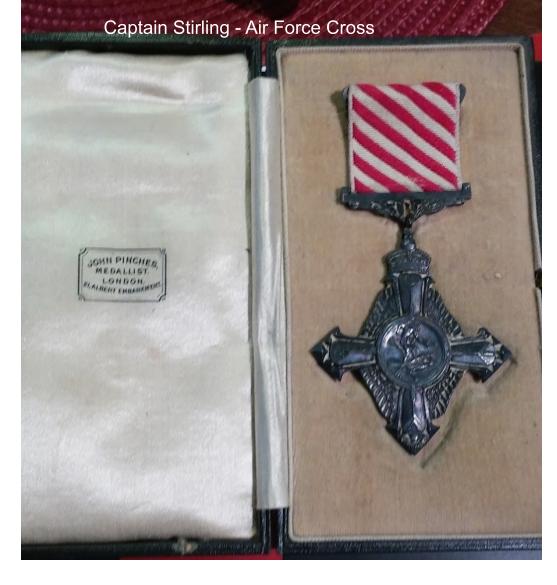
Captain Robert Millar Stirling. Aviator.

It may be hard to believe, but until that time, I had never really heard of my paternal grandfather or his exploits. I had grandparents on my Mom’s side of the family; Grandpa Frank was also a war vet and played the Last Post at all Remembrance Day services in his small town for decades. His son, my Uncle Frank (Mom’s brother) had been shot down on return from a night raid over Essen during WWII. So I guess I conflated war and death and people….because Dad never spoke of his father. I had never met either of them, of course, so… just someone missing in my life. Disappeared. Missing.
In one way, it is simple to understand why Dad never spoke of him until I was older. My father was 10 years old when he and my grandmother were on a boat back to England to visit family. His father, Captain Stirling, died in a plane crash on the Hamilton airport runway in Ontario, while leading the first civilian Canadian Trans-Canada Air Pageant.
My father never saw his father again. Imagine the shock! There was no turning a steamship liner around to allow my grandmother and dad to attend the funeral in Hamilton, Ontario. My Dad never neared his own father’s grave until a winter in the 1960s when he returned from England and his mother’s funeral. He found himself in Hamilton, Ontario (whether by accident or design I don’t know) and he made a trip to the wintery graveyard to finally pay respects to his father, 38 years later.
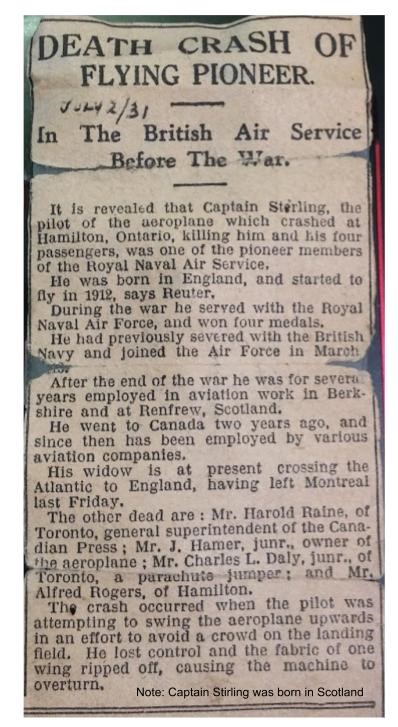
So overall, it makes sense that my paternal grandfather, Captain Robert Millar Stirling, famous in life, became anonymous in death. Invisible to me until that fateful high school assignment.
My father and I were always very close – soulmates. That’s how I describe our relationship. The loss of his Mum was devastating to him. I know that. Even as I child I felt a profound change in him – a former Brit really ‘cut loose’ from his moorings in England.
Though we did not talk about it a lot, I knew he had visited his father’s grave in Hamilton. He’d been there in winter, so he never elaborated on what he’d done or found. I imagined he might have brought a rose or a few to lay on the gravestone and that for him, there was closure.
So, when my father suggested my grandfather, Captain Robert Millar Stirling, as the topic of my history paper, I said ‘sure’ – and started taking notes.

Entry 448:
Nov. 13, 1915 The Royal Aero Club of the United Kingdom, Official Notices to Members reported newly licensed aviators, including:
#668 Ordinary Telegraphist Robert Millar Stirling, R.N. (Bristol Biplane, Naval School, Eastchurch). Oct. 22nd, 1913.
I was a child – a teenager – at the time with a very limited view of history. I took good notes from what my father told me, but it was only years later that I realized how incredible it was that my grandfather, with flying license number 668 from the Scottish Flying Club in 1913, had decided to come to Canada to Baddeck, Nova Scotia. Remember that the Wright Brothers first flew long-ish flights only in 1909!
Why did he choose Nova Scotia? Possibly because Alexander Graham Bell was an aviation fanatic!
Captain Stirling did not remain in Nova Scotia but moved on to being a bush pilot in Quebec. He moved the family to Montreal where they lived on Sherbrooke Street while he flew all over the province on mail and medical runs. I have screenshots of one of his logbooks.
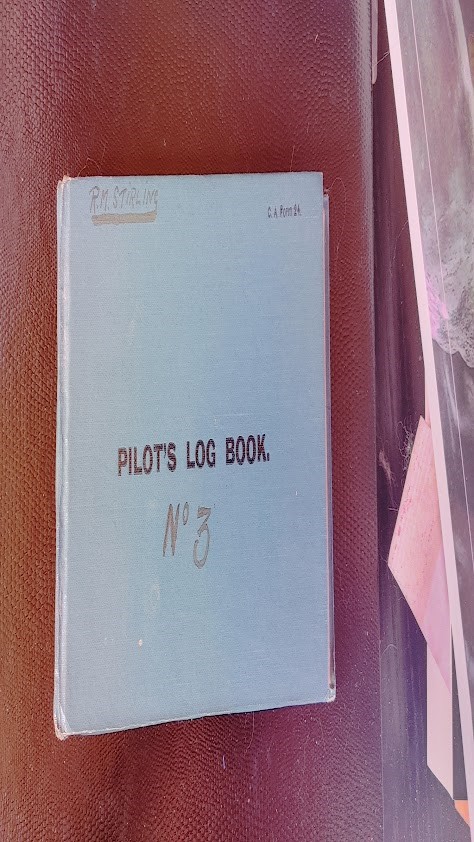


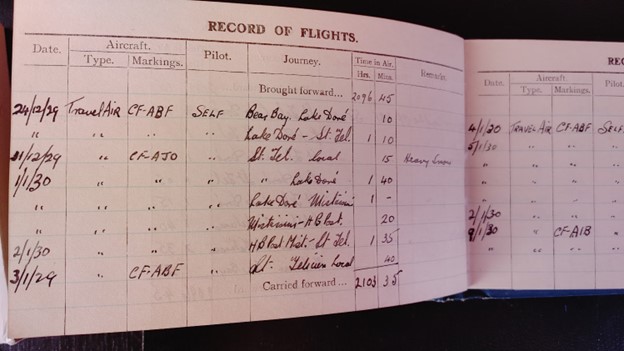
He also brought new technology into Canada, bringing the first Curtiss monoplane to Canada from Maine.
In his time, Captain Stirling was a public figure. He loved flying and he loved doing air shows. It is hard to imagine today how ‘new’ flying was as a concept, or how dangerous. Maybe the best reference is one of my favorite films “Those Magnificent Men Men in their Flying Machines.”
In the 2000’s, I met with a couple of senior Canadian Air Force pilots on a business project and happened to have a picture of my grandfather and his airplane on my desk. They both nodded with respect and said: “Oh. The flying coffin.”

At one point, for reasons unknown to me, Canada’s top professional speed skater gave my father (then a child) a set of speed skates. I suspect it was some kind of honor related to my grandfather – the fellow I never knew. The man that no one talked about when I was growing up.

But my high school history project had ignited a slow burning spark. A curiosity.
So, many decades later, I planned a road trip to New York. I thought that along the way it would be a simple thing to stop in Hamilton, Ontario at Captain Stirling’s grave, offer a symbol of memoriam, perhaps some roses, and somehow complete a circle of life/death/remembrance that my father had started after my grandmother’s passing in England. [For people who don’t live in Canada, Hamilton is 3,174 km (2,083 miles) from Calgary.]
In 2013, after a few emails to the Hamilton Cemetery, I embarked from Alberta on a trip in my late Mom’s van to New York, planning to honor my father and grandfather with a stop in Hamilton.
The Hamilton Cemetery people were very helpful, except for the fact that they referred me to a block of land where there were no grave markers.
What!
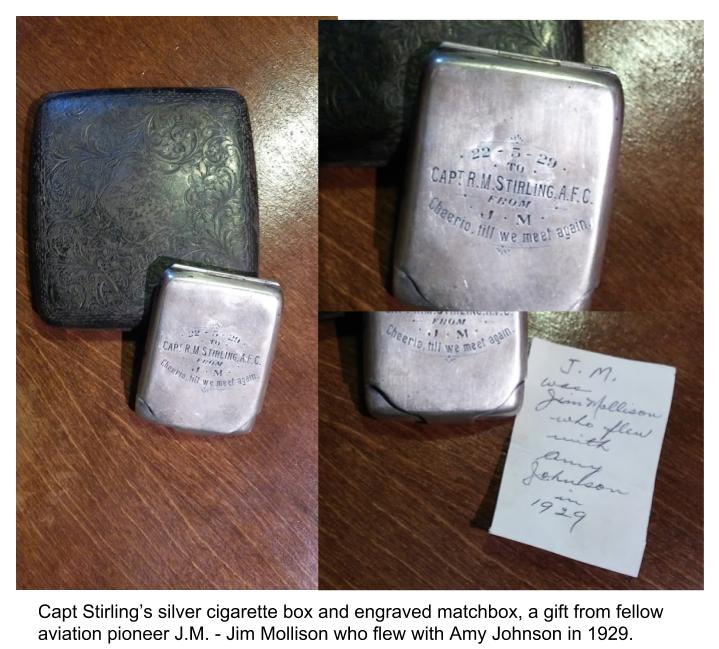
Yes, it turns out that my grandfather, a decorated World War I veteran who received a special letter of distinction from Sir Winston Churchill for his efforts, who was a contemporary of Jim Mollison and Amy Johnson, and who was the leader of the first civilian Trans Canada Air Pageant… lies in an unmarked grave in Hamilton, Ontario.


Cover of event post card courtesy Robin McKee
To me it is clear why his grave is unmarked. His colleagues and promoters were with him on that fateful flight, when, while coming into land, hundreds of people had spilled out onto the runway to watch the plane. To avoid landing ON them, he pulled up sharply on the stick, the stress of which caused the fabric and wooden wing struts to rip apart. The passengers crashed and died – but their sacrifice saved hundreds of others from probable injury and death had Captain Stirling proceeded with the landing path. He did not know that technology and engineering would fail him at a critical time.
Captain Stirling’s wife and son were on their way back to England on a steamship, unable to spin around and return.
Who knows what their financial circumstances were at the time. It is my impression from limited access to documents that Captain Stirling, while adored and revered by his wife Evelyn and many members of the public, was seen as something as a ne’er do well by the parsimonious Scottish end of the family (his own; probably his main financier). My impression is that he was seen as completely impractical by the fruit and vegetable farm family of his wife, who were far too busy harvesting produce and fruits for sale in Covent Gardens to worry about some idiot who wanted to fly across Canada. For what?

The terrible crash in Hamilton left the farm family in Kent, England, ‘saddled’ with the widow and her son, my dad, then a boy of 10. At least the farm family did bring them home. My Gran became the farm manager – to all reports a very good one. But ‘the kid’ was a problem. Not that he misbehaved. Just that he was ‘there.’
It could well be that my paternal grandfather had ‘bet the farm’ on his participation in the Trans Canada Civilian Air Pageant. Maybe he fried all the family’s financial future.

What is clear is that when my dad and my grandmother returned to England, the practical and cultural ‘choice’ was that my dad go to a boarding school (aka residential school). This offered many benefits to my grandmother and her family, who had been kind enough to bring her back into their fold (many families were not so kind to widows with a child – not then; not now!). My grandmother was working, busy as the farm manager, in charge of bookkeeping, logistics, human resources and paymaster – handing out hundreds of weekly cash pay packets to the many workers who came to hand-pick the apples, cherries, hops and produce that Kent farms were famous for. She could work, carefree, most of the year, and in the meantime, her son, my dad, was cared for and educated at Rye Grammar School.
That conditions for my Dad were not perfect is representative of hardships of the times. My Dad recalled how starving Irish farmers made their way to his maternal grandfather’s farm in Kent, looking for work – not for money – but for potatoes. And how my grandmother made sure they left with sacks full of potatoes.
My Dad was not starving – except perhaps for affection.

My Dad related that when he returned home from English Residential School for the holidays, his uncles frequently beat him up and locked him in closets. Meanwhile, at residential school, because my dad was a southpaw (left hand) he was caned until his hands were black and blue; made to stand in the corner with a dunce cap on. Then he was bullied by his fellow students for being a dunce. He was also called “Fatty” and I have a wooden headboard that his classmates had made for him with “RIP Fatty.” Imagine. Classmates who want you dead.
Cruel as this was, it was quite the norm in Britain at the time. Probably the norm in society.
Despite these known offenses against her son, my grandmother and/or her farm family, continued to enroll my dad in Rye Grammar School where he was bullied and threatened ‘all the days of his life.’
And so, decades later, I arrived at the Hamilton Cemetery in May of 2013, expecting to see some kind of memorial or grave marker for Captain Robert Millar Stirling, only to find there was nothing. NOTHING. Not only that, while cemetery staff could provide an ‘area’ description of where he was buried, it was a big ‘area’ – one with no markers!! Not for him!

Captain Stirling is in here, somewhere. Unmarked. But where? Image courtesy Robin McKee.
I was suddenly personally possessed with a sense that I could intuitively ‘find’ his burial spot because of my obvious genetic and spiritual relationship with him. [Just to mention, I have had several undesigned/unrequested unusual ‘prescient’ events happen in my life. As Dad said a few times of me, “You are like your grandmother, a bit of a witch.”]
I felt certain that if I crisscrossed the area I would, at some point, ‘feel’ where he was. Kind of like a human Ground Penetrating Radar scan.
This did not happen. My grandfather is dead and buried. That’s it. That’s the story. Somewhere in Hamilton Cemetery, but I don’t exactly know where though I have spent a few hours ‘near’ there.
And, today, ‘I don’t care.’
I don’t care. Not now.
I do know he was buried with care, and this was documented.
But he is dead.
I am alive.
Shall I spend hours and days and thousands of dollars trying to locate and then exhume his grave to be sure it is him? For what?
What a long ‘dead-end’ narrative. What can be the point, you may be asking.
The point is that almost everyone of us has an ‘unmarked’ grave in our history.
Presently in Canada, the Indigenous community is claiming special rights to land and documents, on the premise that these lands with presumed bodies or human remains are ‘sacred’ and that no one must ever have access to them, unless they are ‘real’ Indigenous people (based on a race-based historical accounting of their Indigenous roots).
But we ALL have unmarked graves in our families, in our past. Why would one set of grounds be ‘more sacred’ than others?
Just as any Indigenous person can access my grandfather Captain Stirling’s records, why should I, a taxpaying Canadian, be blocked from accessing detailed information about Indian Residential Schools – the basis for multi-billion-dollar claims by Indigenous groups over alleged harms they endured while attending Indian Residential School that their parents enrolled them in?
The larger question, why must I pay anything more as penance for educating people who had no written language? People who have since acquired this skill from the dominant society via residential schools and are now posting class actions suits with the very literary skills that millions of taxpaying Canadians have provided them with over the past 150 years.
Sadly, part of the reason of the disconnect with family members, like my Grandfather, lost in the mists of time, is because Indigenous groups only had an oral tradition for carrying on Indigenous history, they do not have as complete a record as I have of my Grandfather’s life – but what I have is honestly also very sparse! And I still don’t know where his grave is!
None-the-less, Indigenous Canadians can likely find out something about their family members who did attend Indian Residential Schools, who, like my Grandfather, are ‘lost in time’ because the Canadian government required all administrators of school facilities and Indian agents to write details of who was who and what was what. Because they could and did write, there is documentation on virtually every single child who was in an Indian Residential School. There may be a few exceptions in the case of orphaned babies; there may be some children who were sent for treatment for TB and then sent on to a different school. I think these would be small anomalies.
I believe that the claims of missing children are related to the Tuberculosis (TB) plague that was prevalent throughout all of society and much of the history of residential schools. I have written about that here.
I am dismayed about one key thing.
People who ~150 years ago could not read, write, or speak English, are now suing/settling Canada and all Canadians on the claim that their cultural truths and practices were harmed, that children disappeared or were murdered at Indian Residential Schools, despite there never having been a missing person report filed in the past 113 years. Despite the fact that the objective of their parents, who had to register the children in schools, was that they just wanted their kids to be cared for and educated while they went off on their trap line or hunting.
Sounds like a different form of $10 day care.
Robert Carney, eminent historian, and father of the famous Mark Carney pointed out in a number of his papers and commentaries that many Indigenous families signed their children up for Indian Residential Schools because they wanted them to have a better future, and the parents had to work – often in very remote locations like a trap line or hunting. That was a precarious world. Many children died in camps or were orphaned…and then taken in to residential schools for care!
While, yes, it was possible to take the kids along, or set the mom and kids up in a mobile camp while the men went forth to kill and harvest game for food or furs, it was much easier to not have to have the kids around while at work. Most parents discovered this during COVID lockdowns when toddlers wandered into the Zoom room, crying and screaming ‘poopee’, in the midst of big business meetings.
Indian Residential Schools are being blamed for having disrupted parenting and the transfer of cultural knowledge, when parents of the time didn’t want their kids to be expert hunter-gatherers. They sent them to Indian Residential Schools so that they could become teachers, scientists, engineers, doctors, and lawyers. As for parenting and ‘cultural genocide’? Well, since 2/3 of Indigenous children did NOT go to Indian Residential Schools, how can ‘cultural genocide’ be the fault of a handful of priests, nuns and ministers? Two-thirds of the child population were untouched by residential schools.
So far it seems the ‘lawyers’ have triumphed. They and the ‘settler’ historians who are rewriting Canadian history to make victims out of every single aboriginal person who ever attended or had anyone in their family attend an Indian Residential School.
Crass as it sounds, now every Indian Residential School unmarked grave is slated to become a cash cow in the reparation claims for the non-existent… or let us say, unproven ‘genocide’ that is now being investigated against Canada by José Francisco Calí Tzay, the UN Special Rapporteur on the Rights of Indigenous Peoples. As Terry Glavin wrote in “The Year of the Graves” – “In the bigger-picture scheme of things, three weeks after the Kamloops story broke, China led a bloc of torture states that included Belarus, Russia, Iran, Syria and North Korea in a condemnation of Canada’s treatment of Indigenous peoples.”
Canada is all in a flurry about election interference by China – but people are blind to the much greater geopolitical impact of the China-instigated genocide investigation, where the unmarked, unexhumed graves are ‘proof’ in the minds of gullible Canadians that we did something terribly wrong…and ‘should pay.’
Canadians seem to not know that when murder or genocide claims are made, there must be evidence, witnesses, an investigation, a trial, cross-examination and… bodies. Especially if there are known locations of graves, and living witnesses who claim to have watched children digging graves in the middle of the night to bury their classmates.
How are these gravesites not cordoned off and excavated by the RCMP as crime scenes? There is nothing culturally sensitive about murder. It’s a crime – if indeed it was committed as claimed. And it was not committed as claimed – then there’s a different crime. Related to mischief, hoax, fraud and much more.
For lack of due diligence and due process based on the accusation of the most heinous crime of genocide, Canadians are allowing Canada to implode – the Canada that my grandfather once tried to bind together by leading the first civilian Trans Canada Air Pageant.
I no longer care about Captain Stirling’s unmarked grave. I do care about the future of this country.
Canada. My home and native land.
- 30 –
Michelle Stirling is a member of the Canadian Association of Journalists. She researched, wrote, and co-produced historical shows about Southern Alberta under the supervision of Dr. Hugh Dempsey, then curator of the Glenbow Museum.
Leave a Reply