Search

Michelle Stirling

Thoughts about Things.

Tag

University of Manitoba

“Nothing Controversial” in Grave Error – My chat with Richard Syrett of Sauga960am @RichardSyrett @Sauga960am

https://www.westernstandard.news/opinion/stirling-nothing-controversial-in-grave-error-indigenous-psychologist/54783

I was happy to chat with Richard Syrett of Sauga96am about a recent article of mine that was published in the Western Standard. The article discussed an interview between Frances Widdowson and Indigenous psychologist Lloyd Hawkeye Robertson (scroll down for full interview). Robertson is an Indigenous psychologist and he found nothing controversial in the book “Grave Error,” a book which has caused a huge kerfuffle in the city of Quesnel, B.C. as explained in my article.

Robertson rejects the notion of ‘genocide’ in Canadian Crown-Indigenous/residential school history though he recognizes that for many people, there is a ‘residential school syndrome‘ which has similarities to Post Traumatic Stress Disorder (PTSD). He has had success with many of his treatment programs. He also affirms that many Indigenous people are Christians and find great comfort and strength in their religion; some others find solace and healing in traditional Indigenous rituals. He sees this as an individual world view – not a ‘one-size-fits-all.’

In my talk with Richard Syrett, I pointed out that there are reasonable explanations as to why many aboriginal people would have experienced a devastating sense of loss – especially since ambiguous losses are numerous in Indigenous communities – and why that might get conflated with the notion of ‘missing children’ at Indian Residential Schools. My view is that we need historical context to make sense of the pain and suffering that many people feel; by filling in those historical gaps – like that related to “The Forgotten Plague” – the tuberculosis epidemic that was the ‘captain of all these men of death‘ since time immemorial, for everyone, this context will help everyone make sense of the past.

In historical terms, tuberculosis was the greatest killer ever known to mankind. Accounts of TB were found in the writings of ancient Egyptians and in those of Hippocrates, and it was called “The Captain of All These Men of Death” by English writer John Bunyan. At its peak in the U.S., it killed one in every four people.

In the same vein, in a Canadian context, I suggest that people also watch “The Necessities of Life/Ce qu’il faut pour vivre” – a beautiful Quebec-made film that really shows the trauma of that era of TB, before we found pharmaceutical cures.

I still think that one of my first articles on the “mass grave” news stories offers people a simple, yet comprehensive overview of the missing historical context in media stories – and addresses the very real suffering of people who went to TB ‘sans’ to be healed, but often they were left ‘wounded’ and displaced from family and friends.

The interview with Richard Syrett is here:

My two books are on Kindle now:

Rational Spaces Disputation interview is here:

I do all this work on my own time. I offer many free resources on this site and on my MEDIUM page. If you’d like to support my research and my efforts to calm the storm and bridge the gaps, to truly reconcile, feel free to help out. Many thanks. (PS sharing material is also good!)

One-Time
Monthly
Yearly

Make a one-time donation

Make a monthly donation

Make a yearly donation

Choose an amount

C$5.00
C$15.00
C$100.00
C$5.00
C$15.00
C$100.00
C$5.00
C$15.00
C$100.00

Or enter a custom amount

C$

Your contribution is appreciated.

Your contribution is appreciated.

Your contribution is appreciated.

DonateDonate monthlyDonate yearly

Featured post

Settler Historians Need More Education, Less Ideology: Rebutting Sean Carleton on Senator Lynn Beyak and Indian Residential Schools

By Michelle Stirling ©2023

Image licensed from Adobe Stock.

Have I been “Beyak-ed?”

Someone has tried to cancel the publication of this paper which rebuts claims made by Sean Carleton of the University of Manitoba, about a paper that he did about Senator Lynn Beyak’s efforts to have people recognize the enormous good that Indian Residential Schools provided for thousands of children. Yes. Some children also suffered harms. Not everyone.

Carleton is a self-described ‘settler historian’ and part of the ever ballooning Indigenous and ‘pretendian’ grievance sector of Canadian society. There seems to be a parallel universe where mainstream Canadian life goes on as normal, while in settler historian-Indigenous grievance circles, there is an ever increasing ‘tab’ that mainstream society must pay for reconciliation. Most taxpayers are completely oblivious to these multi-billion dollar costs for questionable ends. At this point in time, based on the most recent budget, that tab is quite high. Of the approximately $35 billion deficit in the past fiscal year, about $26 billion (74.3%) was for the satisfaction of Indigenous claims. It should be recalled that Canada’s Indigenous population is about 1.8 million. Though people point to the reports of the Truth and Reconciliation Commission (TRC) as evidence of mortal and moral wrongs, it should be remembered that only about 6,000 people (or 4% of the total residential school student base) provided their recollections to the TRC (not subject to evidence or cross-examination); more than 150,000 students went to Indian Residential Schools. Many were orphans, saved from the worst of fates by Indian Residential Schools run by Catholic Sisters and Brothers, or by other Christian denominations. Many who claimed they were forcibly taken to Indian Residential Schools were actually enrolled by their parents (if one looks at the records); and others were rescued from destitute, dysfunctional or dangerous homes.

As Robert Carney wrote, rejecting the Royal Commission on Aboriginal Peoples report of 1996, “The work of the traditional boarding schools is similarly ignored in the chapter’s introductory section. The fact is that in addition to providing basic schooling and training related to local resource use, they served
Native communities in other ways. It would have been fair to acknowledge that many traditional boarding
schools, in some cases well into the twentieth century, took in sick, dying, abandoned, orphaned, physically and mentally handicapped children, from newborns to late adolescents, as well as adults who asked for refuge and other forms of assistance.”

Robert Carney, father of the much more famous Mark Carney (who curiously does not speak out in defence of his father’s life long research) , showed that government and media analysis of Indian Residential Schools were/are flawed from the get-go. Canada’s Indian Residential Schools saved thousands of orphans. Saved children!!

So, here is the abstract of my paper rebutting ‘settler historians’ and their world view. The full document follows. Enjoy!

~~~~

Settler Historians Need More Education, Less Ideology Rebutting Sean Carleton on Senator Beyak and Indian Residential Schools

Canada, once honored worldwide as a nation of peacemakers, is presently accused of genocide by China; condemned as a colonialist purveyor of genocide by a bevy of self-described ‘settler historians’ within Canada. The focus of the alleged ‘genocide’ is the establishment of Indian Residential Schools and the outcomes thereof for some 150,000 Indigenous students over the course of ~100 years. The evidence of this alleged heinous crime is said to be in recollections published in the reports of the Truth and Reconciliation Commission in 2015, which, contrary to Carleton’s abstract, only claimed the schools constituted ‘cultural genocide’ – nothing more. Carleton (2021) assesses the instance of Canadian Senator Lynn Beyak attempting to provide diverse perspectives (typically positive) on Indian Residential Schools as a case of ‘residential school denialism.’ This work will provide historical evidence rebutting Carleton (2021) which presented theories of ‘denialism’ but little actual historical evidence to support his case.

One-Time
Monthly
Yearly

Make a one-time donation

Make a monthly donation

Make a yearly donation

Choose an amount

C$5.00
C$15.00
C$100.00
C$5.00
C$15.00
C$100.00
C$5.00
C$15.00
C$100.00

Or enter a custom amount

C$

Your contribution is appreciated.

Your contribution is appreciated.

Your contribution is appreciated.

DonateDonate monthlyDonate yearly
Confronting Indian Residential School Confabulation and Media Irresponsibility

Responding to Gerbrandt and Carleton’s “Debunking the Mass Grave Hoax”

by Michelle Stirling ©2023 Updated Oct. 27, 2023 to reflect new information about Buffy Sainte-Marie and again Nov. 10, to remove an invalid link.

Canada is in the grip of a ‘mass grave/missing children’ psychosis related to Indian Residential Schools.  The ‘shock and awe’ media campaign that accompanied the statements by the Kamloops First Nation in May of 2021 claiming that clandestinely buried children’s bodies or remains had been found in an orchard thanks to a Ground Penetrating Radar (GPR) search sent shock waves around the world.[1]  Contrary to claims in the Reid Gerbrandt – Sean Carleton report, “Debunking the “Mass Grave Hoax”: A Report on Media Coverage and Residential School Denialism in Canada” the media never corrected these stories.

https://www.theglobeandmail.com/canada/alberta/article-historic-catholic-church-in-alberta-first-nation-community-burned-to/

In addition to rebutting the Gerbrandt-Carleton media claims, this report incorporates a number of articles that set the context of some historical events. I also have included a rebuttal to a Sean Carleton paper, regarding the cancel culture that led to the dismissal of Senator Lynn Beyak from the Canadian Senate. Think of this as a plain language media kit on Canadian history relevant to Indian Residential Schools.

This report was updated Nov. 10, 2023 to remove an invalid link.

In this document, I make scant reference to the mistreatment or abuse of former Indian Residential School students, simply because the Canadian government has spent >$60 million and about 8 years documenting those statements, and we are spending >$60 billion in compensation and reconciliatory programs on a population of less than 1.8 million Indigenous people – not all of whom ever went to Indian Residential School of any kind, and so many Indigenous do not qualify for compensation – creating inequity. Despite this huge compensation, most Indigenous people will still live in poverty, with no fresh water and lack of housing while the media continue their focus on witch hunts of elderly Christian Sisters, Brothers, Fathers, and priests, who dedicated their lives to the service of their students, many of whom were orphans.

I am looking for media accuracy, inclusion of historical context in Indian Residential School reporting, and rational reconciliation. I do not ascribe to a ‘settler historian’ view of the world and do not support a grievance industry.

Notice when you are holding onto a grievance. How many minor and major irritations and grievances occupy your thinking throughout the day? What do we sacrifice when our attention is centered on grievances? Heed Hayek’s warning: A “decent society” cannot survive when a critical mass of people is focused on grievances. Living for grievances means risking our humanity and liberty. https://www.aier.org/article/to-live-for-grievances-risks-liberty/

Schedule N of the Truth and Reconciliation Commission.


[1] https://cfjctoday.com/2021/05/27/tkemlups-confirms-bodies-of-215-children-buried-at-former-kamloops-indian-residential-school-site/ 

Featured post

Canadian Government is Funding its Own Indian Residential School Genocide Claim

By Michelle Stirling ©2023

Most governments, at least those of the West, abhor genocide – a heinous crime described by the UN Geneva Convention as:

 The definition contained in Article II of the Convention describes genocide as a crime committed with the intent to destroy a national, ethnic, racial or religious group, in whole or in part. It does not include political groups or so called “cultural genocide”.

https://www.un.org/en/genocideprevention/genocide.shtml

The consequences for participating in a genocide can be imprisonment or execution.

So, it is strange that the government of Canada – the entire House of Commons – accepted NDP MP Leah Gazan’s motion of Oct. 27, 2022 to ‘describe’ Indian Residential Schools as genocide, without debate or evidence presented.

Stranger still that the federal government is pumping millions of dollars into the University of Manitoba for the National Centre for Truth and Reconciliation (NCTR), when all that organization appears to be doing is falsifying and rewriting Canadian history and it has not even managed to make public the provincial death records that were handed over to its predecessor – the Truth and Reconciliation Commission – in 2014. 

A decade later, the NCTR, an organization operated by the University of Manitoba, with a mandate to make all such public records available to the public, still has not done that.

Why?

Is it because the facts of history would destroy the genocide narrative?

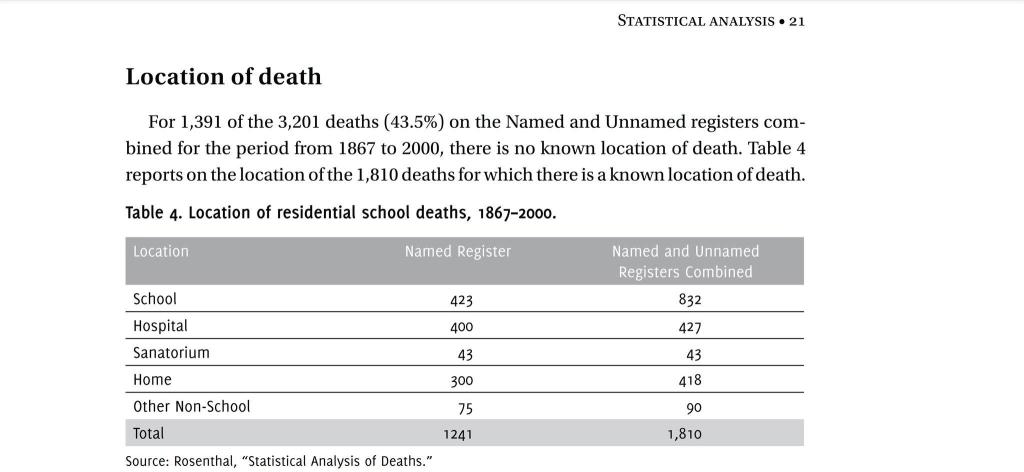
The historical documents show that most children enrolled in Indian Residential Schools were enrolled by their parents. Rather than thousands of deaths as alleged, there are 423 who died at Indian Residential Schools.  That’s out of 150,000 attendees over the course of 113 years.  Some genocide.

So, the historical documents show that what Marie Wilson, Commissioner of the Truth and Reconciliation Commission said in 2015 is not true:

Parents had their children ripped out of their arms, taken to a distant and unknown place never to be seen again, buried in an unmarked grave, long ago forgotten and overgrown.[6]

The records show that parents voluntarily enrolled their children to these schools.  Parents were allowed to visit (though sometimes distance precluded that). Children returned home for festive and summer holidays – unless the children were orphans or if their home was dysfunctional and dangerous.  In that case, those children might have been apprehended – ‘ripped out of their arms’ – to protect the child from serious alcoholism, physical or sexual abuse, or simple neglect in the home.

Even dysfunctional parents love their children, but can society allow small children to remain in a home alone when the parents might be gone either trapping or drinking for days on end?

Independent researcher Nina Green has painstakingly analyzed the death records by Indian Residential School and band in British Columbia. She has identified the cause of death and where the child’s body was buried (with few exceptions) and created an excel chart that anyone can review. (See the two files below)

The death records from the provinces that Nina has compiled for British Columbia show that the children were accounted for and most of those who sadly passed away, were sent home for burial on reserve.  In extenuating circumstances, they were buried in the mission or community graveyard near the school with full burial rites according to their family’s denomination, and with a marker, that has disintegrated over time.  The cause of death is also noted.

How can an individual researcher like Nina Green accomplish this work alone when a multi-million-dollar tax-funded operation, soon to occupy a multi-million-dollar edifice on the University of Manitoba campus, fails to even get the death records posted and available to the public as per their mandate?

Why is the federal government and a major tax-funded Canadian university driving the genocide narrative on Indian Residential Schools – in flagrant opposition to the evidence – creating strife, division, mistrust, fear and complicated grief for so many Canadians, especially Indigenous people.

Why would the federal government push such a narrative when China has accused Canada of genocide at the UN, along with a handful of other terror states?

Why wouldn’t the Canadian government and all politicians at all levels of government want to defend this country and our citizens from false charges?

Now it is clear why key players in this drama are urging the government to make Indian Residential School ‘denial’ – and the presentation of facts like these – a criminal offense.

Is it to cover up the falsification of history and the fact the Canadian taxpayer is being defrauded?

What is the end game? We don’t know.

According to Nina Green’s research, the Memorial Register of the NCTR includes names of people who died unrelated to Indian Residential Schools, thus creating a false impression that thousands of children died there or are missing. Screenshot above from this CTV News story of Sept. 30, 2019.

-30 –

Michelle Stirling is a member of the Canadian Association of Journalists. She researched, wrote, and co-produced historical shows about Southern Alberta under the supervision of Dr. Hugh Dempsey, then curator of the Glenbow Museum. She also researched and co-wrote a documentary on genocide; the factual content so dark the producer decided not to release it.

Note: I know that many people are suffering from many losses. Please see “Ambiguous Losses: Epidemics, Orphans and Unmarked Graves” for more historical context and insights.

Here’s a bizarre anomaly – 22 Canadian lawyers petitioning to have Canada brought before the International Criminal Court.

Powered by Woo

Up ↑