I was happy to chat with Richard Syrett of Sauga96am about a recent article of mine that was published in the Western Standard. The article discussed an interview between Frances Widdowson and Indigenous psychologist Lloyd Hawkeye Robertson (scroll down for full interview). Robertson is an Indigenous psychologist and he found nothing controversial in the book “Grave Error,” a book which has caused a huge kerfuffle in the city of Quesnel, B.C. as explained in my article.
Robertson rejects the notion of ‘genocide’ in Canadian Crown-Indigenous/residential school history though he recognizes that for many people, there is a ‘residential school syndrome‘ which has similarities to Post Traumatic Stress Disorder (PTSD). He has had success with many of his treatment programs. He also affirms that many Indigenous people are Christians and find great comfort and strength in their religion; some others find solace and healing in traditional Indigenous rituals. He sees this as an individual world view – not a ‘one-size-fits-all.’
In my talk with Richard Syrett, I pointed out that there are reasonable explanations as to why many aboriginal people would have experienced a devastating sense of loss – especially since ambiguous losses are numerous in Indigenous communities – and why that might get conflated with the notion of ‘missing children’ at Indian Residential Schools. My view is that we need historical context to make sense of the pain and suffering that many people feel; by filling in those historical gaps – like that related to “The Forgotten Plague” – the tuberculosis epidemic that was the ‘captain of all these men of death‘ since time immemorial, for everyone, this context will help everyone make sense of the past.
In historical terms, tuberculosis was the greatest killer ever known to mankind. Accounts of TB were found in the writings of ancient Egyptians and in those of Hippocrates, and it was called “The Captain of All These Men of Death” by English writer John Bunyan. At its peak in the U.S., it killed one in every four people.
In the same vein, in a Canadian context, I suggest that people also watch “The Necessities of Life/Ce qu’il faut pour vivre” – a beautiful Quebec-made film that really shows the trauma of that era of TB, before we found pharmaceutical cures.
I still think that one of my first articles on the “mass grave” news stories offers people a simple, yet comprehensive overview of the missing historical context in media stories – and addresses the very real suffering of people who went to TB ‘sans’ to be healed, but often they were left ‘wounded’ and displaced from family and friends.
I do all this work on my own time. I offer many free resources on this site and on my MEDIUM page. If you’d like to support my research and my efforts to calm the storm and bridge the gaps, to truly reconcile, feel free to help out. Many thanks. (PS sharing material is also good!)
Most governments, at least those of the West, abhor genocide – a heinous crime described by the UN Geneva Convention as:
The definition contained in Article II of the Convention describes genocide as a crime committed with the intent to destroy a national, ethnic, racial or religious group, in whole or in part. It does not include political groups or so called “cultural genocide”.
The consequences for participating in a genocide can be imprisonment or execution.
So, it is strange that the government of Canada – the entire House of Commons – accepted NDP MP Leah Gazan’s motion of Oct. 27, 2022 to ‘describe’ Indian Residential Schools as genocide, without debate or evidence presented.
Stranger still that the federal government is pumping millions of dollars into the University of Manitoba for the National Centre for Truth and Reconciliation (NCTR), when all that organization appears to be doing is falsifying and rewriting Canadian history and it has not even managed to make public the provincial death records that were handed over to its predecessor – the Truth and Reconciliation Commission – in 2014.
A decade later, the NCTR, an organization operated by the University of Manitoba, with a mandate to make all such public records available to the public, still has not done that.
Why?
Is it because the facts of history would destroy the genocide narrative?
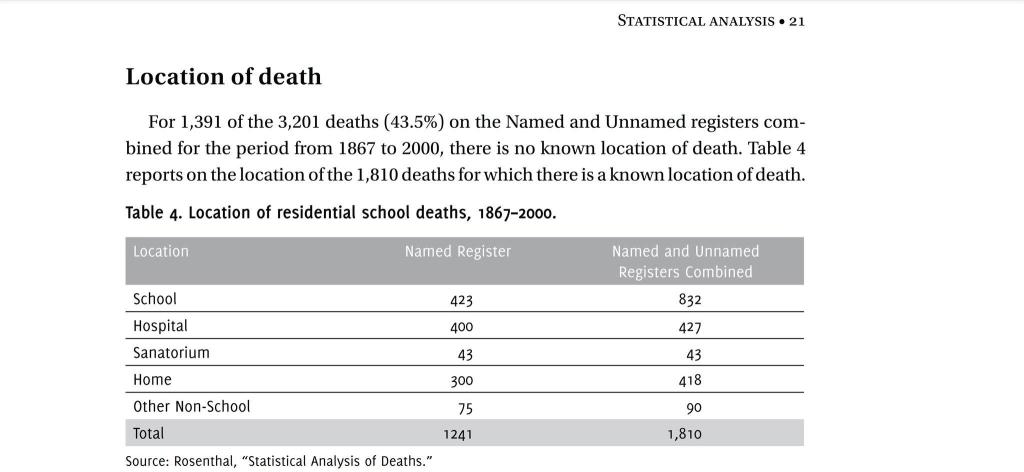
The historical documents show that most children enrolled in Indian Residential Schools were enrolled by their parents. Rather than thousands of deaths as alleged, there are 423 who died at Indian Residential Schools. That’s out of 150,000 attendees over the course of 113 years. Some genocide.
So, the historical documents show that what Marie Wilson, Commissioner of the Truth and Reconciliation Commission said in 2015 is not true:
Parents had their children ripped out of their arms, taken to a distant and unknown place never to be seen again, buried in an unmarked grave, long ago forgotten and overgrown.[6]
The records show that parents voluntarily enrolled their children to these schools. Parents were allowed to visit (though sometimes distance precluded that). Children returned home for festive and summer holidays – unless the children were orphans or if their home was dysfunctional and dangerous. In that case, those children might have been apprehended – ‘ripped out of their arms’ – to protect the child from serious alcoholism, physical or sexual abuse, or simple neglect in the home.
Even dysfunctional parents love their children, but can society allow small children to remain in a home alone when the parents might be gone either trapping or drinking for days on end?
Independent researcher Nina Green has painstakingly analyzed the death records by Indian Residential School and band in British Columbia. She has identified the cause of death and where the child’s body was buried (with few exceptions) and created an excel chart that anyone can review. (See the two files below)
The death records from the provinces that Nina has compiled for British Columbia show that the children were accounted for and most of those who sadly passed away, were sent home for burial on reserve. In extenuating circumstances, they were buried in the mission or community graveyard near the school with full burial rites according to their family’s denomination, and with a marker, that has disintegrated over time. The cause of death is also noted.
How can an individual researcher like Nina Green accomplish this work alone when a multi-million-dollar tax-funded operation, soon to occupy a multi-million-dollar edifice on the University of Manitoba campus, fails to even get the death records posted and available to the public as per their mandate?
Why is the federal government and a major tax-funded Canadian university driving the genocide narrative on Indian Residential Schools – in flagrant opposition to the evidence – creating strife, division, mistrust, fear and complicated grief for so many Canadians, especially Indigenous people.
Why would the federal government push such a narrative when China has accused Canada of genocide at the UN, along with a handful of other terror states?
Why wouldn’t the Canadian government and all politicians at all levels of government want to defend this country and our citizens from false charges?
Now it is clear why key players in this drama are urging the government to make Indian Residential School ‘denial’ – and the presentation of facts like these – a criminal offense.
Is it to cover up the falsification of history and the fact the Canadian taxpayer is being defrauded?
What is the end game? We don’t know.
According to Nina Green’s research, the Memorial Register of the NCTR includes names of people who died unrelated to Indian Residential Schools, thus creating a false impression that thousands of children died there or are missing. Screenshot above from this CTV News story of Sept. 30, 2019.
-30 –
Michelle Stirling is a member of the Canadian Association of Journalists. She researched, wrote, and co-produced historical shows about Southern Alberta under the supervision of Dr. Hugh Dempsey, then curator of the Glenbow Museum. She also researched and co-wrote a documentary on genocide; the factual content so dark the producer decided not to release it.
I am very concerned right now about the situation in Canada, regarding the claims of genocide and the search for unmarked graves and missing children.
I’m very sad that the international media has picked up the story and is calling it a hoax. Because I think a lot of people are really hurting.
I think that a lot of people are missing loved ones. I think a lot of those losses are what’s called ‘ambiguous losses,’ where people left your life, or some traumatic event happened, and your life changed dramatically.
And I think a lot of the focus of these ambiguous losses have been put under the umbrella of the Indian Residential Schools as the only reason for all the grief and loss.
So I wanted to tell you a bit of a story, when I was in Calgary in the 1990’s, I was walking down the street and this fellow stopped and asked me something. And I answered him in Blackfoot. And we both started laughing, probably because my Blackfoot wasn’t very good. But he was surprised. Anyway, we got a couple of sandwiches, we went and sat in the park, and we talked for a while.
His name was Fred Yellow Old Woman. I got to know him, like, pretty well. We weren’t best of friends, but we ran into each other quite a bit. He told me a very interesting and moving Blackfoot story, which I thought probably should be turned into a play. So he actually took me to the Blackfoot elders and asked their permission if I could turn it into a play and I did that. But unfortunately, that play is in an attic somewhere overseas.
And I’m here.
But let me tell you what it was about.
And I think that it’s okay that I just tell you, because I did have permission to write it.
It’s about the fact that all of us are stones.
We are all like stones. We’re all the same and we’re all different, all at the same time. Some of us are big stones, we are strong. We don’t need anybody. And some of us are small stones and we’re blue and we’re sad. And I think the stones of the people who are missing their loved ones are like this stone… which reminds me of my brother. And I actually keep it by his photo. On the outside it looks black and not very interesting. On the inside it’s red and like a wound, because he died a few years ago, and I still miss him.
And some people are probably …blue.
They are like blue stones. They also are hollowed out inside, maybe from depression, loss, fear.
And other people are stones with healing going on inside.
Where that loss is gradually moving on and growing into some new strength. The wound is still there, but there’s new life. And some people have maybe taken their grief and moved it into something pure, and some sense of purpose, maybe living for the person whose life was lost.
Because, you know, when we lose someone we love, I don’t think any person who has gone to the other side wants you to spend your life in sorrow….over them going on.
That was their path, not yours.
Your path is here.
So, I think many people take that loss and turn it into something constructive for themselves.
So I see that there’s a lot of anger right now in all of the communities in Canada about this whole issue.
There are some people who feel that it is a hoax, that there are no missing children or unmarked graves. People are demanding, ‘let’s see the body’ which is not the thing.
Even if you found a body of someone, in a grave, that just means that someone died.
You know, back in the day, when a lot of these graveyards were set up and the ground was sanctified by the church that was running that mission outpost..a lot of people died then from illness.
You know, if you got a little cut on your finger and it got infected, without antibiotics back then, you could die just from that. Or a broken leg if it wasn’t set properly, you could die from that.
And of course, TB – tuberculosis – was very prevalent back then.
So, thousands of people died of TB. In fact, in one book I read, the author said that in 1908, in Canada, every hour of the day, one Canadian died of tuberculosis. And at night, two people died every hour from tuberculosis.
And there was no cure. Up until about the 1950s when they developed streptomycin, I think it is, and some vaccines, there was no cure.
And it was a very sneaky kind of disease, you could have it for a long time and you wouldn’t know, necessarily, that you had it. Maybe you got more tired, maybe a few body functions didn’t work as well, maybe sometimes when you coughed, blood would come up, and then all of a sudden there could be a catastrophic hemorrhage from your lung.
And that would be it.
So, and at other times, it was actually known as ‘consumption’ because it would literally eat a person away from the inside out. Just made them into a skinny wreck.
So I think, you know, if people haven’t studied Canadian history a lot, then they might have a lot of false impressions about what went on.
You know, I see online people say “Well, why would a school have a graveyard?”
The main reason is that a school was usually set up beside a Christian Mission first, and the mission outpost always had a graveyard because, like I said, so many people did die in those days. And the whole purpose was to sanctify the body and bury it in sanctified ground and release the spirit back to G-d, the Creator, the Great Beyond, whatever you want to call it. And then after that, the residential school was built nearby. So that’s why there was a graveyard.
And there are some residential schools that were kind of built in the middle of nowhere – they also had a graveyard, because also people died. And you know it wasn’t only people, children going to residential schools who died from time to time.
As Robert Carney wrote in several of his writings before there were social services and Universal Health Care, these outposts, these residential schools and missions, this was the only place that anyone could go for help. So if you were a traveler going across Canada, a prospector, a trader of some kind, and you needed help, let’s say you got hurt or your wife was going to have a baby, or you were hungry, maybe you were not successful on the hunt…the place that you went was to the mission or the residential school. And they gave whatever help they could, but sometimes people died.
So there will be people in these graves who aren’t necessarily identified. Because, back in the day, a lot of people didn’t even carry ID. What did you need it for? Out in the middle of the prairie.
So these are some of the things, the facts of history, that we have to look at, that we have to be willing to consider.
We can’t just be demanding bodies, and we can’t be saying that even if there is a body there was something nefarious or evil done, because so many people died back then…just of disease.
And you know, there probably will be some mass graves found, if people continue looking, and that would be related to things like Spanish Flu. Because when the Spanish Flu epidemic hit, it would wipe out whole groups of people. Whole families. You know, 10-20 people at a time. Because it struck very rapidly. Someone could have a fever in the morning and be dead by evening.
And if that was happening in a community, there was no one to bury bodies one by one.
So, there are instances, and they are documented that the best thing they could do was to dig a grave and put a lot of people there. Usually they tried to document who died.
But again, I’ve read passages in Saskatchewan you know the harvesters would come from Ontario, down east, to come and work the harvest out on the prairies, you’d have 9 or 10 guys in a boxcar coming west for harvest time, and they’d open the boxcar and they’d all be dead. From Spanish Flu.
And that was a strange flu. You know, it hit for a couple of years, I think it was 1918 to 1920 and it came in two waves, and then it went away. That was it.
But in that time, it also took a lot of parents. It hit young adults hardest. And it left a lot of orphans. And a lot of those orphans ended up going to residential school – that became their home.
So, I hope that gives you some insights.
And… uh.. I probably talked long enough. But, I hope that we can calm the situation down, and talk with each other.